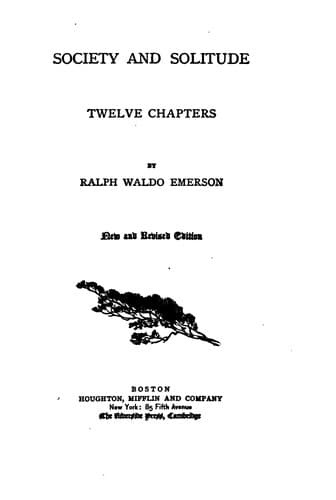
Society and solitude: Twelve chaptersEmerson, Ralph Waldo
Philosophy
Society and solitude: Twelve chapters
Emerson, Ralph Waldo
American essays -- 19th century
He that can define, he that can answer a question so as to admit of no
further answer, is the best man. This was the meaning of the story of
the Sphinx. In the old time conundrums were sent from king to king by
ambassadors. The seven wise masters at Periander’s banquet spent their
time in answering them. The life of Socrates is a propounding and a
solution of these. So, in the hagiology of each nation, the lawgiver
was in each case some man of eloquent tongue, whose sympathy brought
him face to face with the extremes of society. Jesus, Menu, the first
Buddhist, Mahomet, Zertusht, Pythagoras, are examples.
Jesus spent his life in discoursing with humble people on life and
duty, in giving wise answers, showing that he saw at a larger angle
of vision, and at least silencing those who were not generous enough
to accept his thoughts. Luther spent his life so; and it is not his
theologic works,--his “Commentary on the Galatians,” and the rest,
but his “Table-Talk” which is still read by men. Dr. Johnson was
a man of no profound mind,--full of English limitations, English
politics, English Church, Oxford philosophy; yet having a large heart,
mother-wit, and good sense, which impatiently overleaped his customary
bounds, his conversation as reported by Boswell has a lasting charm.
Conversation is the vent of character as well as of thought; and Dr.
Johnson impresses his company, not only by the point of the remark, but
also, when the point fails, because _he_ makes it. His obvious religion
or superstition, his deep wish that they should think so or so, weighs
with them,--so rare is depth of feeling, or a constitutional value for
a thought or opinion, among the light-minded men and women who make up
society; and though they know that there is in the speaker a degree
of shortcoming, of insincerity, and of talking for victory, yet the
existence of character, and habitual reverence for principles over
talent or learning, is felt by the frivolous.
One of the best records of the great German master, who towered over
all his contemporaries in the first thirty years of this century, is
his conversations as recorded by Eckermann; and the “Table-Talk” of
Coleridge is one of the best remains of his genius.
Public-domain text, read in full here on John Shaqi.
Reviews
Reviews
No reviews yet
Be the first to share your thoughts on this work.
Elsewhere in the archive
Join the Discussion
Join the discussion
Sign in to leave a comment or review.
Sign InorCreate an account