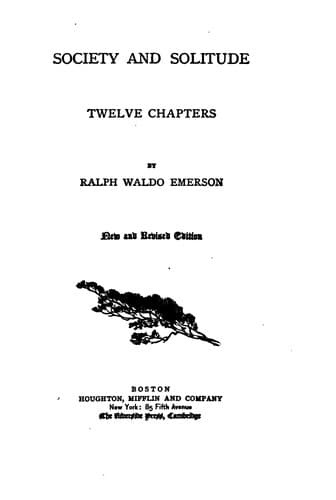
Society and solitude: Twelve chaptersEmerson, Ralph Waldo
Philosophy
Society and solitude: Twelve chapters
Emerson, Ralph Waldo
American essays -- 19th century
In the Norse legends, the gods of Valhalla, when they meet the Jotuns,
converse on the perilous terms that he who cannot answer the other’s
questions forfeits his own life. Odin comes to the threshold of the
Jotun Waftrhudnir in disguise, calling himself Gangrader; is invited
into the hall, and told that he cannot go out thence unless he can
answer every question Waftrhudnir shall put. Waftrhudnir asks him the
name of the god of the sun, and of the god who brings the night; what
river separates the dwellings of the sons of the giants from those of
the gods; what plain lies between the gods and Surtur, their adversary,
etc.; all which the disguised Odin answers satisfactorily. Then it is
his turn to interrogate, and he is answered well for a time by the
Jotun. At last he puts a question which none but himself could answer:
“What did Odin whisper in the ear of his son Balder, when Balder
mounted the funeral pile?” The startled giant replies: “None of the
gods knows what in the old time THOU saidst in the ear of thy son: with
death on my mouth have I spoken the fate-words of the generation of the
Æsir; with Odin contended I in wise words. Thou must ever the wisest
be.”
And still the gods and giants are so known, and still they play the
same game in all the million mansions of heaven and of earth; at all
tables, clubs, and _tête-à-têtes_, the lawyers in the court-house,
the senators in the capitol, the doctors in the academy, the wits in
the hotel. Best is he who gives an answer that cannot be answered
again. _Omnis definitio periculosa est_, and only wit has the secret.
The same thing took place when Leibnitz came to visit Newton; when
Schiller came to Goethe; when France, in the person of Madame de Staël,
visited Goethe and Schiller; when Hegel was the guest of Victor Cousin
in Paris; when Linnæus was the guest of Jussieu. It happened many
years ago, that an American chemist carried a letter of introduction
to Dr. Dalton of Manchester, England, the author of the theory of
atomic proportions, and was coolly enough received by the Doctor in the
laboratory where he was engaged. Only Dr. Dalton scratched a formula
on a scrap of paper and pushed it towards the guest,--“Had he seen
that?” The visitor scratched on another paper a formula describing
some results of his own with sulphuric acid, and pushed it across the
table,--“Had he seen that?” The attention of the English chemist was
instantly arrested, and they became rapidly acquainted. To answer a
question so as to admit of no reply, is the test of a man,--to touch
bottom every time. Hyde, Earl of Rochester, asked Lord-Keeper Guilford,
“Do you not think I could understand any business in England in a
month?” “Yes, my Lord,” replied the other, “but I think you would
understand it better in two months.” When Edward I. claimed to be
acknowledged by the Scotch (1292) as lord paramount, the nobles of
Scotland replied, “No answer can be made while the throne is vacant.”
When Henry III.
Public-domain text, read in full here on John Shaqi.
Reviews
Reviews
No reviews yet
Be the first to share your thoughts on this work.
Elsewhere in the archive
Join the Discussion
Join the discussion
Sign in to leave a comment or review.
Sign InorCreate an account