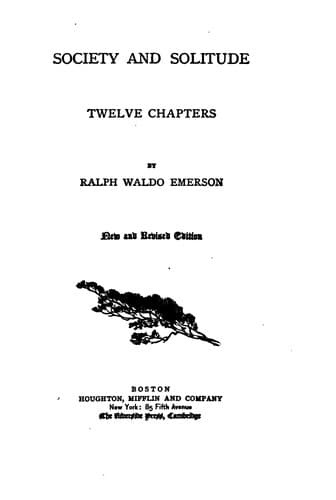
Society and solitude: Twelve chaptersEmerson, Ralph Waldo
Philosophy
Society and solitude: Twelve chapters
Emerson, Ralph Waldo
American essays -- 19th century
It is possible that the best conversation is between two persons who
can talk only to each other. Even Montesquieu confessed that, in
conversation, if he perceived he was listened to by a third person,
it seemed to him from that moment the whole question vanished from
his mind. I have known persons of rare ability who were heavy company
to good, social men who knew well enough how to draw out others of
retiring habit; and, moreover, were heavy to intellectual men who ought
to have known them. And does it never occur that we, perhaps, live with
people too superior to be seen,--as there are musical notes too high
for the scale of most ears? There are men who are great only to one or
two companions of more opportunity, or more adapted.
It was to meet these wants that in all civil nations attempts have been
made to organize conversation by bringing together cultivated people
under the most favorable conditions. ’Tis certain there was liberal
and refined conversation in the Greek, in the Roman, and in the Middle
Age. There was a time when in France a revolution occurred in domestic
architecture; when the houses of the nobility, which, up to that time,
had been constructed on feudal necessities, in a hollow square,--the
ground-floor being resigned to offices and stables, and the floors
above to rooms of state and to lodging-rooms,--were rebuilt with new
purpose. It was the Marchioness of Rambouillet who first got the horses
out of and the scholars into the palaces, having constructed her
_hôtel_ with a view to society, with superb suites of drawing-rooms
on the same floor, and broke through the _morgue_ of etiquette by
inviting to her house men of wit and learning as well as men of rank,
and piqued the emulation of Cardinal Richelieu to rival assemblies,
and so to the founding of the French Academy. The history of the Hôtel
Rambouillet and its brilliant circles makes an important date in French
civilization. And a history of clubs from early antiquity, tracing the
efforts to secure liberal and refined conversation, through the Greek
and Roman to the Middle Age, and thence down through French, English,
and German memoirs, tracing the clubs and coteries in each country,
would be an important chapter in history. We know well the Mermaid
Club, in London, of Shakspeare, Ben Jonson, Chapman, Herrick, Selden,
Beaumont and Fletcher; its “Rules” are preserved, and many allusions
to their suppers are found in Jonson, Herrick, and in Aubrey. Anthony
Wood has many details of Harrington’s Club. Dr. Bentley’s Club held
Newton, Wren, Evelyn, and Locke; and we owe to Boswell our knowledge of
the club of Dr. Johnson, Goldsmith, Burke, Gibbon, Reynolds, Garrick,
Beauclerk, and Percy. And we have records of the brilliant society that
Edinburgh boasted in the first decade of this century. Such societies
are possible only in great cities, and are the compensation which these
can make to their dwellers for depriving them of the free intercourse
with Nature.
Public-domain text, read in full here on John Shaqi.
Reviews
Reviews
No reviews yet
Be the first to share your thoughts on this work.
Elsewhere in the archive
Join the Discussion
Join the discussion
Sign in to leave a comment or review.
Sign InorCreate an account