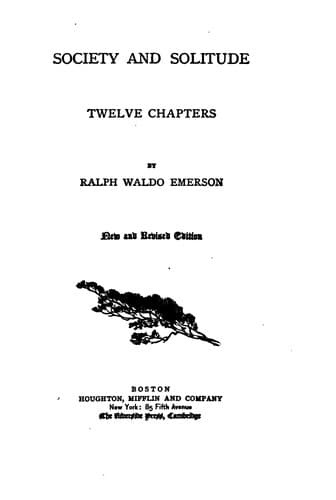
Society and solitude: Twelve chaptersEmerson, Ralph Waldo
Philosophy
Society and solitude: Twelve chapters
Emerson, Ralph Waldo
American essays -- 19th century
(1217) plead duress against his people demanding
confirmation and execution of the Charter, the reply was: “If this were
admitted, civil wars could never close but by the extirpation of one of
the contending parties.”
What can you do with one of these sharp respondents? What can you do
with an eloquent man? No rules of debate, no contempt of court, no
exclusions, no gag-laws can be contrived, that his first syllable will
not set aside or overstep and annul. You can shut out the light, it may
be; but can you shut out gravitation? You may condemn his book; but
can you fight against his thought? That is always too nimble for you,
anticipates you, and breaks out victorious in some other quarter. Can
you stop the motions of good sense? What can you do with Beaumarchais,
who converts the censor whom the court has appointed to stifle his
play into an ardent advocate? The court appoints another censor, who
shall crush it this time. Beaumarchais persuades him to defend it. The
court successively appoints three more severe inquisitors; Beaumarchais
converts them all into triumphant vindicators of the play which is
to bring in the Revolution. Who can stop the mouth of Luther,--of
Newton?--of Franklin,--of Mirabeau,--of Talleyrand?
These masters can make good their own place, and need no patron. Every
variety of gift--science, religion, politics, letters, art, prudence,
war, or love--has its vent and exchange in conversation. Conversation
is the Olympic games whither every superior gift resorts to assert
and approve itself,--and, of course, the inspirations of powerful
and public men, with the rest. But it is not this class,--whom the
splendor of their accomplishment almost inevitably guides into the
vortex of ambition, makes them chancellors and commanders of council
and of action, and makes them at last fatalists,--not these whom we
now consider. We consider those who are interested in thoughts, their
own and other men’s, and who delight in comparing them, who think it
the highest compliment they can pay a man, to deal with him as an
intellect, to expose to him the grand and cheerful secrets perhaps
never opened to their daily companions, to share with him the sphere of
freedom and the simplicity of truth.
But the best conversation is rare. Society seems to have agreed to
treat fictions as realities, and realities as fictions; and the simple
lover of truth, especially if on very high grounds,--as a religious or
intellectual seeker,--finds himself a stranger and alien.
Public-domain text, read in full here on John Shaqi.
Reviews
Reviews
No reviews yet
Be the first to share your thoughts on this work.
Elsewhere in the archive
Join the Discussion
Join the discussion
Sign in to leave a comment or review.
Sign InorCreate an account