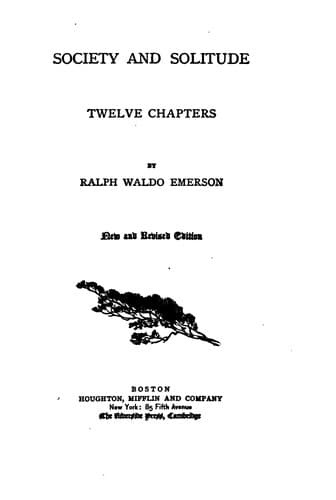
Society and solitude: Twelve chaptersEmerson, Ralph Waldo
Philosophy
Society and solitude: Twelve chapters
Emerson, Ralph Waldo
American essays -- 19th century
These feats are measures or traits of civility; and temperate climate
is an important influence, though not quite indispensable, for there
have been learning, philosophy, and art in Iceland, and in the tropics.
But one condition is essential to the social education of man, namely,
morality. There can be no high civility without a deep morality, though
it may not always call itself by that name, but sometimes the point
of honor, as in the institution of chivalry; or patriotism, as in the
Spartan and Roman republics; or the enthusiasm of some religious sect
which imputes its virtue to its dogma; or the cabalism, or _esprit de
corps_, of a masonic or other association of friends.
The evolution of a highly-destined society must be moral; it must run
in the grooves of the celestial wheels. It must be catholic in aims.
What is _moral_? It is the respecting in action catholic or universal
ends. Hear the definition which Kant gives of moral conduct: “Act
always so that the immediate motive of thy will may become a universal
rule for all intelligent beings.”
Civilization depends on morality. Everything good in man leans on what
is higher. This rule holds in small as in great. Thus, all our strength
and success in the work of our hands depend on our borrowing the aid of
the elements. You have seen a carpenter on a ladder with a broad-axe
chopping upward chips from a beam. How awkward! at what disadvantage he
works! But see him on the ground, dressing his timber under him. Now,
not his feeble muscles, but the force of gravity brings down the axe;
that is to say, the planet itself splits his stick. The farmer had much
ill-temper, laziness, and shirking to endure from his hand-sawyers,
until one day he bethought him to put his saw-mill on the edge of a
waterfall; and the river never tires of turning his wheel: the river is
good-natured, and never hints an objection.
We had letters to send: couriers could not go fast enough, nor far
enough; broke their wagons, foundered their horses; bad roads in
spring, snow-drifts in winter, heats in summer; could not get the
horses out of a walk. But we found out that the air and earth were
full of Electricity; and always going our way,--just the way we wanted
to send. _Would he take a message?_ Just as lief as not; had nothing
else to do; would carry it in no time. Only one doubt occurred, one
staggering objection,--he had no carpet-bag, no visible pockets, no
hands, not so much as a mouth, to carry a letter. But, after much
thought and many experiments, we managed to meet the conditions, and
to fold up the letter in such invisible compact form as he could
carry in those invisible pockets of his, never wrought by needle and
thread,--and it went like a charm.
Public-domain text, read in full here on John Shaqi.
Reviews
Reviews
No reviews yet
Be the first to share your thoughts on this work.
Join the Discussion
Join the discussion
Sign in to leave a comment or review.
Sign InorCreate an account