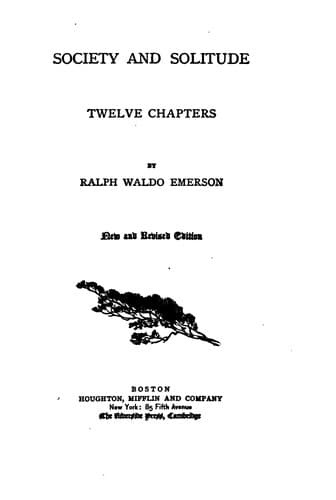
Society and solitude: Twelve chaptersEmerson, Ralph Waldo
Philosophy
Society and solitude: Twelve chapters
Emerson, Ralph Waldo
American essays -- 19th century
Hippocrates in Greece knew how to stay the devouring plague which
ravaged Athens in his time, and his skill died with him. Dr. Benjamin
Rush, in Philadelphia, carried that city heroically through the yellow
fever of the year 1793. Leverrier carries the Copernican system in
his head, and knew where to look for the new planet. We have seen an
American woman write a novel of which a million copies were sold in
all languages, and which had one merit, of speaking to the universal
heart, and was read with equal interest to three audiences, namely,
in the parlor, in the kitchen, and in the nursery of every house. We
have seen women who could institute hospitals and schools in armies.
We have seen a woman who by pure song could melt the souls of whole
populations. And there is no limit to these varieties of talent.
These are arts to be thankful for,--each one as it is a new direction
of human power. We cannot choose but respect them. Our civilization
is made up of a million contributions of this kind. For success, to
be sure, we esteem it a test in other people, since we do first in
ourselves. We respect ourselves more if we have succeeded. Neither do
we grudge to each of these benefactors the praise or the profit which
accrues from his industry.
Here are already quite different degrees of moral merit in these
examples. I don’t know but we and our race elsewhere set a higher value
on wealth, victory, and coarse superiority of all kinds, than other
men,--have less tranquillity of mind, are less easily contented. The
Saxon is taught from his infancy to wish to be first. The Norseman
was a restless rider, fighter, freebooter. The ancient Norse ballads
describe him as afflicted with this inextinguishable thirst of victory.
The mother says to her son:--
“Success shall be in thy courser tall,
Success in thyself, which is best of all,
Success in thy hand, success in thy foot,
In struggle with man, in battle with brute:--
The holy God and Saint Drothin dear
Shall never shut eyes on thy career;
Look out, look out, Svend Vonved!”
These feats that we extol do not signify so much as we say. These
boasted arts are of very recent origin. They are local conveniences,
but do not really add to our stature. The greatest men of the world
have managed not to want them. Newton was a great man, without
telegraph, or gas, or steam-coach, or rubber-shoes, or lucifer-matches,
or ether for his pain; so was Shakspeare, and Alfred, and Scipio, and
Socrates. These are local conveniences, but how easy to go now to parts
of the world where not only all these arts are wanting, but where they
are despised. The Arabian sheiks, the most dignified people in the
planet, do not want them; yet have as much self-respect as the English,
and are easily able to impress the Frenchman or the American who visits
them with the respect due to a brave and sufficient man.
Public-domain text, read in full here on John Shaqi.
Reviews
Reviews
No reviews yet
Be the first to share your thoughts on this work.
Elsewhere in the archive
Join the Discussion
Join the discussion
Sign in to leave a comment or review.
Sign InorCreate an account