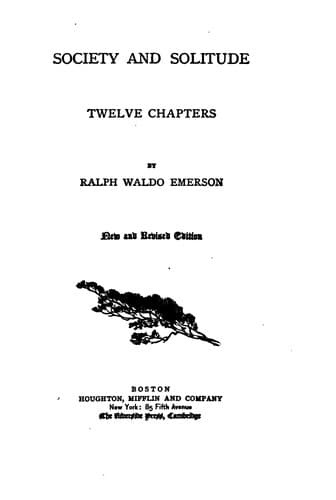
Society and solitude: Twelve chaptersEmerson, Ralph Waldo
Philosophy
Society and solitude: Twelve chapters
Emerson, Ralph Waldo
American essays -- 19th century
These feats have, to be sure, great difference of merit and some of
them involve power of a high kind. But the public values the invention
more than the inventor does. The inventor knows there is much more and
better where this came from. The public sees in it a lucrative secret.
Men see the reward which the inventor enjoys, and they think, ‘How
shall we win that?’ Cause and effect are a little tedious; how to
leap to the result by short or by false means? We are not scrupulous.
What we ask is victory, without regard to the cause; after the Rob
Roy rule, after the Napoleon rule, to be the strongest to-day,--the
way of the Talleyrands,--prudent people, whose watches go faster than
their neighbors’, and who detect the first moment of decline, and
throw themselves on the instant on the winning side. I have heard that
Nelson used to say, “Never mind the justice or the impudence, only let
me succeed.” Lord Brougham’s single duty of counsel is, “to get the
prisoner clear.” Fuller says ’tis a maxim of lawyers, “that a crown
once worn cleareth all defects of the wearer thereof.” _Rien ne réussit
mieux que le succès._ And we Americans are tainted with this insanity,
as our bankruptcies and our reckless politics may show. We are great by
exclusion, grasping, and egotism. Our success takes from all what it
gives to one. ’Tis a haggard, malignant, careworn running for luck.
Egotism is a kind of buckram that gives momentary strength and
concentration to men, and seems to be much used in nature for fabrics
in which local and spasmodic energy is required. I could point to men
in this country of indispensable importance to the carrying on of
American life, of this humor, whom we could ill spare; any one of them
would be a national loss. But it spoils conversation. They will not
try conclusions with you. They are ever thrusting this pampered self
between you and them. It is plain they have a long education to undergo
to reach simplicity and plain-dealing, which are what a wise man mainly
cares for in his companion. Nature knows how to convert evil to good;
Nature utilizes misers, fanatics, show-men, egotists, to accomplish her
ends; but we must not think better of the foible for that. The passion
for sudden success is rude and puerile, just as war, cannons, and
executions are used to clear the ground of bad, lumpish, irreclaimable
savages, but always to the damage of the conquerors.
Public-domain text, read in full here on John Shaqi.
Reviews
Reviews
No reviews yet
Be the first to share your thoughts on this work.
Elsewhere in the archive
Join the Discussion
Join the discussion
Sign in to leave a comment or review.
Sign InorCreate an account