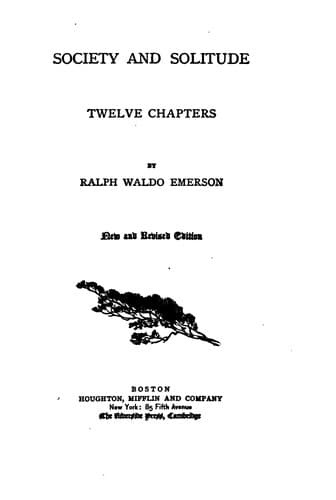
Society and solitude: Twelve chaptersEmerson, Ralph Waldo
Philosophy
Society and solitude: Twelve chapters
Emerson, Ralph Waldo
American essays -- 19th century
I hate this shallow Americanism which hopes to get rich by credit,
to get knowledge by raps on midnight tables, to learn the economy of
the mind by phrenology, or skill without study, or mastery without
apprenticeship, or the sale of goods through pretending that they sell,
or power through making believe you are powerful, or through a packed
jury or caucus, bribery and “repeating” votes, or wealth by fraud.
They think they have got it, but they have got something else,--a
crime which calls for another crime, and another devil behind that;
these are steps to suicide, infamy, and the harming of mankind. We
countenance each other in this life of show, puffing, advertisement,
and manufacture of public opinion; and excellence is lost sight of in
the hunger for sudden performance and praise.
There was a wise man, an Italian artist, Michel Angelo, who writes thus
of himself: “Meanwhile the Cardinal Ippolito, in whom all my best hopes
were placed, being dead, I began to understand that the promises of
this world are, for the most part, vain phantoms, and that to confide
in one’s self, and become something of worth and value, is the best and
safest course.” Now, though I am by no means sure that the reader will
assent to all my propositions, yet I think we shall agree in my first
rule for success,--that we shall drop the brag and the advertisement,
and take Michel Angelo’s course, “to confide in one’s self, and be
something of worth and value.”
Each man has an aptitude born with him to do easily some feat
impossible to any other. Do your work. I have to say this often, but
nature says it oftener. ’Tis clownish to insist on doing all with
one’s own hands, as if every man should build his own clumsy house,
forge his hammer, and bake his dough; but he is to dare to do what
he can do best; not help others as they would direct him, but as he
knows his helpful power to be. To do otherwise is to neutralize all
those extraordinary special talents distributed among men. Yet, whilst
this self-truth is essential to the exhibition of the world and to the
growth and glory of each mind, it is rare to find a man who believes
his own thought or who speaks that which he was created to say. As
nothing astonishes men so much as common sense and plain-dealing, so
nothing is more rare in any man than an act of his own. Any work looks
wonderful to him, except that which he can do. We do not believe our
own thought; we must serve somebody; we must quote somebody; we dote
on the old and the distant; we are tickled by great names; we import
the religion of other nations; we quote their opinions; we cite their
laws. The gravest and learnedest courts in this country shudder to face
a new question, and will wait months and years for a case to occur that
can be tortured into a precedent, and thus throw on a bolder party the
_onus_ of an initiative. Thus we do not carry a counsel in our breasts,
or do not know it; and because we cannot shake off from our shoes this
Public-domain text, read in full here on John Shaqi.
Reviews
Reviews
No reviews yet
Be the first to share your thoughts on this work.
Elsewhere in the archive
Join the Discussion
Join the discussion
Sign in to leave a comment or review.
Sign InorCreate an account