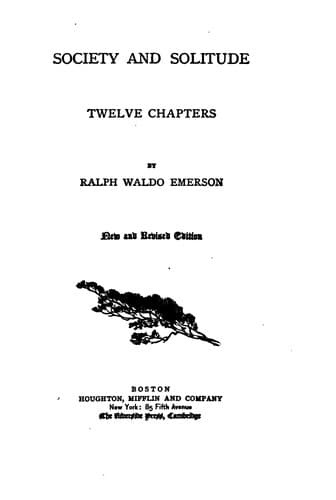
Society and solitude: Twelve chaptersEmerson, Ralph Waldo
Philosophy
Society and solitude: Twelve chapters
Emerson, Ralph Waldo
American essays -- 19th century
Is there no loving of knowledge, and of art, and of our design, for
itself alone? Cannot we please ourselves with performing our work, or
gaining truth and power, without being praised for it? I gain my point,
I gain all points, if I can reach my companion with any statement
which teaches him his own worth. The sum of wisdom is, that the time
is never lost that is devoted to work. The good workman never says,
‘There, that will do’; but, ‘There, that is it: try it, and come again,
it will last always.’ If the artist, in whatever art, is well at work
on his own design, it signifies little that he does not yet find orders
or customers. I pronounce that young man happy who is content with
having acquired the skill which he had aimed at, and waits willingly
when the occasion of making it appreciated shall arrive, knowing well
that it will not loiter. The time your rival spends in dressing up his
work for effect, hastily, and for the market, you spend in study and
experiments towards real knowledge and efficiency. He has thereby sold
his picture or machine, or won the prize, or got the appointment; but
you have raised yourself into a higher school of art, and a few years
will show the advantage of the real master over the short popularity of
the showman. I know it is a nice point to discriminate this self-trust,
which is the pledge of all mental vigor and performance, from the
disease to which it is allied,--the exaggeration of the part which we
can play;--yet they are two things. But it is sanity to know, that,
over my talent or knack, and a million times better than any talent,
is the central intelligence which subordinates and uses all talents;
and it is only as a door into this, that any talent or the knowledge it
gives is of value. He only who comes into this central intelligence,
in which no egotism or exaggeration can be, comes into self-possession.
My next point is that, in the scale of powers, it is not talent, but
sensibility, which is best: talent confines, but the central life
puts us in relation to all. How often it seems the chief good to be
born with a cheerful temper, and well adjusted to the tone of the
human race. Such a man feels himself in harmony, and conscious by
his receptivity of an infinite strength. Like Alfred, “good fortune
accompanies him like a gift of God.” Feel yourself, and be not daunted
by things. ’Tis the fulness of man that runs over into objects, and
makes his Bibles and Shakspeares and Homers so great. The joyful reader
borrows of his own ideas to fill their faulty outline, and knows not
that he borrows and gives.
Public-domain text, read in full here on John Shaqi.
Reviews
Reviews
No reviews yet
Be the first to share your thoughts on this work.
Elsewhere in the archive
Join the Discussion
Join the discussion
Sign in to leave a comment or review.
Sign InorCreate an account