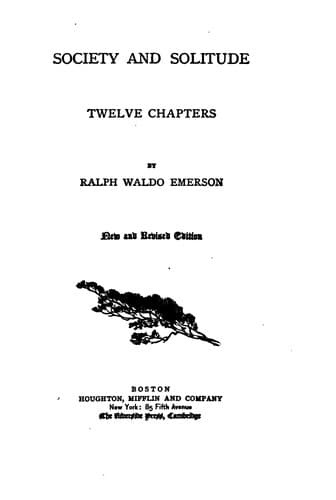
Society and solitude: Twelve chaptersEmerson, Ralph Waldo
Philosophy
Society and solitude: Twelve chapters
Emerson, Ralph Waldo
American essays -- 19th century
There is something of poverty in our criticism. We assume that there
are few great men, all the rest are little; that there is but one
Homer, but one Shakspeare, one Newton, one Socrates. But the soul in
her beaming hour does not acknowledge these usurpations. We should know
how to praise Socrates, or Plato, or Saint John, without impoverishing
us. In good hours we do not find Shakspeare or Homer over-great,--only
to have been translators of the happy present,--and every man and woman
divine possibilities. ’Tis the good reader that makes the good book; a
good head cannot read amiss: in every book he finds passages which seem
confidences or asides hidden from all else and unmistakably meant for
his ear.
The light by which we see in this world comes out from the soul of
the observer. Wherever any noble sentiment dwelt, it made the faces
and houses around to shine. Nay, the powers of this busy brain are
miraculous and illimitable. Therein are the rules and formulas by which
the whole empire of matter is worked. There is no prosperity, trade,
art, city, or great material wealth of any kind, but if you trace it
home, you will find it rooted in a thought of some individual man.
Is all life a surface affair? ’Tis curious, but our difference of wit
appears to be only a difference of impressionability, or power to
appreciate faint, fainter, and infinitely faintest voices and visions.
When the scholar or the writer has pumped his brain for thoughts and
verses, and then comes abroad into Nature, has he never found that
there is a better poetry hinted in a boy’s whistle of a tune, or in
the piping of a sparrow, than in all his literary results? We call
it health. What is so admirable as the health of youth?--with his
long days because his eyes are good, and brisk circulations keep him
warm in cold rooms, and he loves books that speak to the imagination;
and he can read Plato, covered to his chin with a cloak in a cold
upper chamber, though he should associate the Dialogues ever after
with a woollen smell. ’Tis the bane of life that natural effects are
continually crowded out, and artificial arrangements substituted.
We remember when, in early youth, the earth spoke and the heavens
glowed; when an evening, any evening, grim and wintry, sleet and snow,
was enough for us; the houses were in the air. Now it costs a rare
combination of clouds and lights to overcome the common and mean. What
is it we look for in the landscape, in sunsets and sunrises, in the sea
and the firmament? what but a compensation for the cramp and pettiness
of human performances? We bask in the day, and the mind finds somewhat
as great as itself. In Nature, all is large, massive repose. Remember
what befalls a city boy who goes for the first time into the October
woods. He is suddenly initiated into a pomp and glory that brings to
pass for him the dreams of romance. He is the king he dreamed he was;
he walks through tents of gold, through bowers of crimson, porphyry,
Public-domain text, read in full here on John Shaqi.
Reviews
Reviews
No reviews yet
Be the first to share your thoughts on this work.
Elsewhere in the archive
Join the Discussion
Join the discussion
Sign in to leave a comment or review.
Sign InorCreate an account