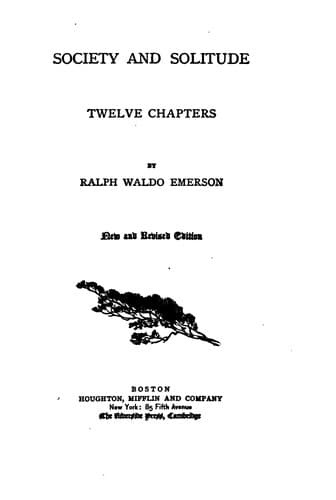
Society and solitude: Twelve chaptersEmerson, Ralph Waldo
Philosophy
Society and solitude: Twelve chapters
Emerson, Ralph Waldo
American essays -- 19th century
If we can thus ride in Olympian chariots by putting our works in the
path of the celestial circuits, we can harness also evil agents, the
powers of darkness, and force them to serve against their will the ends
of wisdom and virtue. Thus, a wise government puts fines and penalties
on pleasant vices. What a benefit would the American government, not
yet relieved of its extreme need, render to itself, and to every city,
village, and hamlet in the States, if it would tax whiskey and rum
almost to the point of prohibition! Was it Bonaparte who said that he
found vices very good patriots?--“he got five millions from the love of
brandy, and he should be glad to know which of the virtues would pay
him as much.” Tobacco and opium have broad backs, and will cheerfully
carry the load of armies, if you choose to make them pay high for such
joy as they give and such harm as they do.
These are traits, and measures, and modes; and the true test of
civilization is, not the census, nor the size of cities, nor the
crops,--no, but the kind of man the country turns out. I see the vast
advantages of this country, spanning the breadth of the temperate
zone. I see the immense material prosperity,--towns on towns, states
on states, and wealth piled in the massive architecture of cities;
California quartz-mountains dumped down in New York to be repiled
architecturally along-shore from Canada to Cuba, and thence westward
to California again. But it is not New York streets built by the
confluence of workmen and wealth of all nations, though stretching out
towards Philadelphia until they touch it, and northward until they
touch New Haven, Hartford, Springfield, Worcester, and Boston,--not
these that make the real estimation. But, when I look over this
constellation of cities which animate and illustrate the land, and
see how little the government has to do with their daily life, how
self-helped and self-directed all families are,--knots of men in purely
natural societies,--societies of trade, of kindred blood, of habitual
hospitality, house and house, man acting on man by weight of opinion,
of longer or better-directed industry, the refining influence of
women, the invitation which experience and permanent causes open to
youth and labor,--when I see how much each virtuous and gifted person,
whom all men consider, lives affectionately with scores of excellent
people who are not known far from home, and perhaps with great reason
reckons these people his superiors in virtue, and in the symmetry and
force of their qualities, I see what cubic values America has, and
in these a better certificate of civilization than great cities or
enormous wealth.
Public-domain text, read in full here on John Shaqi.
Reviews
Reviews
No reviews yet
Be the first to share your thoughts on this work.
Join the Discussion
Join the discussion
Sign in to leave a comment or review.
Sign InorCreate an account