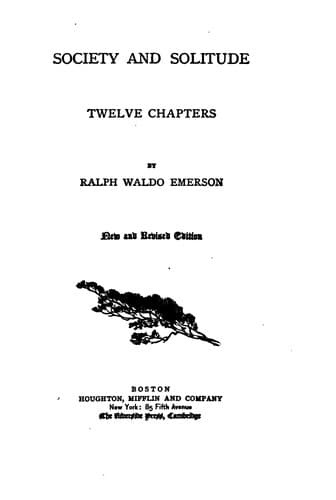
Society and solitude: Twelve chaptersEmerson, Ralph Waldo
Philosophy
Society and solitude: Twelve chapters
Emerson, Ralph Waldo
American essays -- 19th century
This sensibility appears in the homage to beauty which exalts the
faculties of youth, in the power which form and color exert upon
the soul; when we see eyes that are a compliment to the human race,
features that explain the Phidian sculpture. Fontenelle said: “There
are three things about which I have curiosity, though I know nothing of
them,--music, poetry, and love.” The great doctors of this science are
the greatest men,--Dante, Petrarch, Michel Angelo, and Shakspeare. The
wise Socrates treats this matter with a certain archness, yet with very
marked expressions. “I am always,” he says, “asserting that I happen to
know, I may say, nothing but a mere trifle relating to matters of love;
yet in that kind of learning I lay claim to being more skilled than
any one man of the past or present time.” They may well speak in this
uncertain manner of their knowledge, and in this confident manner of
their will, for the secret of it is hard to detect, so deep it is; and
yet genius is measured by its skill in this science.
Who is he in youth, or in maturity, or even in old age, who does not
like to hear of those sensibilities which turn curled heads round at
church, and send wonderful eye-beams across assemblies, from one to
one, never missing in the thickest crowd. The keen statist reckons by
tens and hundreds; the genial man is interested in every slipper that
comes into the assembly. The passion, alike everywhere, creeps under
the snows of Scandinavia, under the fires of the equator, and swims in
the seas of Polynesia. Lofn is as puissant a divinity in the Norse Edda
as Camadeva in the red vault of India, Eros in the Greek, or Cupid in
the Latin heaven. And what is specially true of love is, that it is a
state of extreme impressionability; the lover has more senses and finer
senses than others; his eye and ear are telegraphs; he reads omens on
the flower, and cloud, and face, and form, and gesture, and reads them
aright. In his surprise at the sudden and entire understanding that is
between him and the beloved person, it occurs to him that they might
somehow meet independently of time and place. How delicious the belief
that he could elude all guards, precautions, ceremonies, means, and
delays, and hold instant and sempiternal communication! In solitude, in
banishment, the hope returned, and the experiment was eagerly tried.
The supernal powers seem to take his part. What was on his lips to say
is uttered by his friend. When he went abroad, he met, by wonderful
casualties, the one person he sought. If in his walk he chanced to look
back, his friend was walking behind him. And it has happened that the
artist has often drawn in his pictures the face of the future wife whom
he had not yet seen.
Public-domain text, read in full here on John Shaqi.
Reviews
Reviews
No reviews yet
Be the first to share your thoughts on this work.
Elsewhere in the archive
Join the Discussion
Join the discussion
Sign in to leave a comment or review.
Sign InorCreate an account