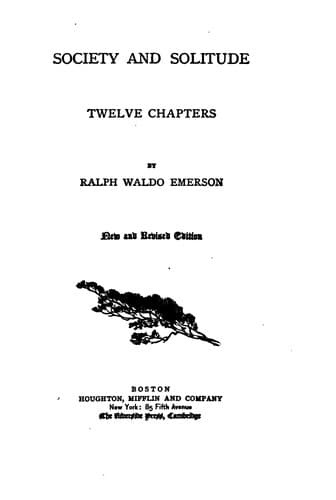
Society and solitude: Twelve chaptersEmerson, Ralph Waldo
Philosophy
Society and solitude: Twelve chapters
Emerson, Ralph Waldo
American essays -- 19th century
’Tis cheap and easy to destroy. There is not a joyful boy or an
innocent girl buoyant with fine purposes of duty, in all the street
full of eager and rosy faces, but a cynic can chill and dishearten with
a single word. Despondency comes readily enough to the most sanguine.
The cynic has only to follow their hint with his bitter confirmation,
and they check that eager courageous pace and go home with heavier step
and premature age. They will themselves quickly enough give the hint he
wants to the cold wretch. Which of them has not failed to please where
they most wished it? or blundered where they were most ambitious of
success? or found themselves awkward or tedious or incapable of study,
thought, or heroism, and only hoped by good sense and fidelity to do
what they could and pass unblamed? And this witty malefactor makes
their little hope less with satire and scepticism, and slackens the
springs of endeavor. Yes, this is easy; but to help the young soul, add
energy, inspire hope, and blow the coals into a useful flame; to redeem
defeat by new thought, by firm action, that is not easy, that is the
work of divine men.
We live on different planes or platforms. There is an external life,
which is educated at school, taught to read, write, cipher, and trade;
taught to grasp all the boy can get, urging him to put himself forward,
to make himself useful and agreeable in the world, to ride, run, argue,
and contend, unfold his talents, shine, conquer, and possess.
But the inner life sits at home, and does not learn to do things, nor
value these feats at all. ’Tis a quiet, wise perception. It loves
truth, because it is itself real; it loves right, it knows nothing
else; but it makes no progress; was as wise in our first memory of
it as now; is just the same now in maturity and hereafter in age, it
was in youth. We have grown to manhood and womanhood; we have powers,
connection, children, reputations, professions: this makes no account
of them all. It lives in the great present; it makes the present great.
This tranquil, well-founded, wide-seeing soul is no express-rider, no
attorney, no magistrate: it lies in the sun, and broods on the world.
A person of this temper once said to a man of much activity, “I will
pardon you that you do so much, and you me that I do nothing.” And
Euripides says that “Zeus hates busybodies and those who do too much.”
OLD AGE.
OLD AGE.
Public-domain text, read in full here on John Shaqi.
Reviews
Reviews
No reviews yet
Be the first to share your thoughts on this work.
Elsewhere in the archive
Join the Discussion
Join the discussion
Sign in to leave a comment or review.
Sign InorCreate an account