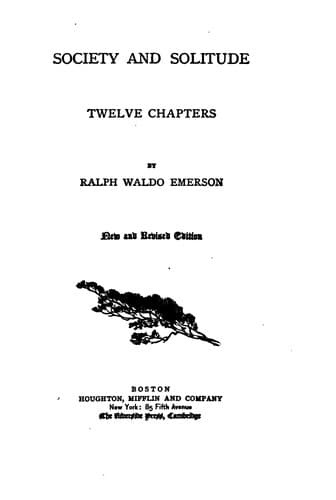
Society and solitude: Twelve chaptersEmerson, Ralph Waldo
Philosophy
Society and solitude: Twelve chapters
Emerson, Ralph Waldo
American essays -- 19th century
On the anniversary of the Phi Beta Kappa Society at Cambridge, in 1861,
the venerable President Quincy, senior member of the Society, as well
as senior alumnus of the University, was received at the dinner with
peculiar demonstrations of respect. He replied to these compliments
in a speech, and, gracefully claiming the privileges of a literary
society, entered at some length into an Apology for Old Age, and,
aiding himself by notes in his hand, made a sort of running commentary
on Cicero’s chapter “De Senectute.” The character of the speaker, the
transparent good faith of his praise and blame, and the _naïveté_ of
his eager preference of Cicero’s opinions to King David’s, gave unusual
interest to the College festival. It was a discourse full of dignity,
honoring him who spoke and those who heard.
The speech led me to look over at home--an easy task--Cicero’s famous
essay, charming by its uniform rhetorical merit; heroic with Stoical
precepts; with a Roman eye to the claims of the State; happiest,
perhaps, in his praise of life on the farm; and rising at the
conclusion to a lofty strain. But he does not exhaust the subject;
rather invites the attempt to add traits to the picture from our
broader modern life.
Cicero makes no reference to the illusions which cling to the element
of time, and in which Nature delights. Wellington, in speaking of
military men, said, “What masks are these uniforms to hide cowards!”
I have often detected the like deception in the cloth shoe, wadded
pelisse, wig, spectacles, and padded chair of Age. Nature lends herself
to these illusions, and adds dim sight, deafness, cracked voice, snowy
hair, short memory and sleep. These also are masks, and all is not Age
that wears them. Whilst we yet call ourselves young, and our mates
are yet youths with even boyish remains, one good fellow in the set
prematurely sports a gray or a bald head, which does not impose on
us who know how innocent of sanctity or of Platonism he is, but does
deceive his juniors and the public, who presently distinguish him with
a most amusing respect: and this lets us into the secret, that the
venerable forms that so awed our childhood were just such impostors.
Nature is full of freaks, and now puts an old head on young shoulders,
and then a young heart beating under fourscore winters.
Public-domain text, read in full here on John Shaqi.
Reviews
Reviews
No reviews yet
Be the first to share your thoughts on this work.
Elsewhere in the archive
Join the Discussion
Join the discussion
Sign in to leave a comment or review.
Sign InorCreate an account