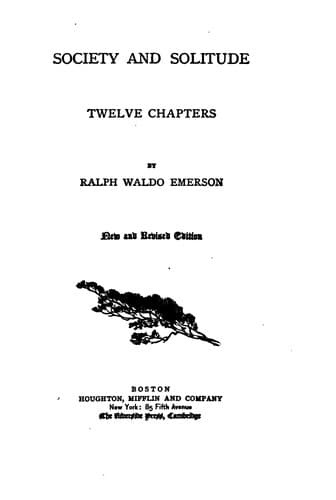
Society and solitude: Twelve chaptersEmerson, Ralph Waldo
Philosophy
Society and solitude: Twelve chapters
Emerson, Ralph Waldo
American essays -- 19th century
But not to press too hard on these deceits and illusions of Nature,
which are inseparable from our condition, and looking at age under
an aspect more conformed to the common sense, if the question be
the felicity of age, I fear the first popular judgments will be
unfavorable. From the point of sensuous experience, seen from the
streets and markets and the haunts of pleasure and gain, the estimate
of age is low, melancholy, and sceptical. Frankly face the facts,
and see the result. Tobacco, coffee, alcohol, hashish, prussic acid,
strychnine, are weak dilutions: the surest poison is time. This cup,
which Nature puts to our lips, has a wonderful virtue, surpassing
that of any other draught. It opens the senses, adds power, fills us
with exalted dreams, which we call hope, love, ambition, science:
especially, it creates a craving for larger draughts of itself.
But they who take the larger draughts are drunk with it, lose their
stature, strength, beauty, and senses, and end in folly and delirium.
We postpone our literary work until we have more ripeness and skill to
write, and we one day discover that our literary talent was a youthful
effervescence which we have now lost. We had a judge in Massachusetts
who at sixty proposed to resign, alleging that he perceived a certain,
decay in his faculties; he was dissuaded by his friends, on account
of the public convenience at that time. At seventy it was hinted to
him that it was time to retire; but he now replied, that he thought
his judgment as robust, and all his faculties as good as ever they
were. But besides the self-deception, the strong and hasty laborers of
the street do not work well with the chronic valetudinarian. Youth is
everywhere in place. Age, like woman, requires fit surroundings. Age
is comely in coaches, in churches, in chairs of state, and ceremony,
in council-chambers, in courts of justice, and historical societies.
Age is becoming in the country. But in the rush and uproar of Broadway,
if you look into the faces of the passengers, there is dejection or
indignation in the seniors, a certain concealed sense of injury,
and the lip made up with a heroic determination not to mind it. Few
envy the consideration enjoyed by the oldest inhabitant. We do not
count a man’s years, until he has nothing else to count. The vast
inconvenience of animal immortality was told in the fable of Tithonus.
In short, the creed of the street is, Old Age is not disgraceful, but
immensely disadvantageous. Life is well enough, but we shall all be
glad to get out of it, and they will all be glad to have us.
Public-domain text, read in full here on John Shaqi.
Reviews
Reviews
No reviews yet
Be the first to share your thoughts on this work.
Elsewhere in the archive
Join the Discussion
Join the discussion
Sign in to leave a comment or review.
Sign InorCreate an account