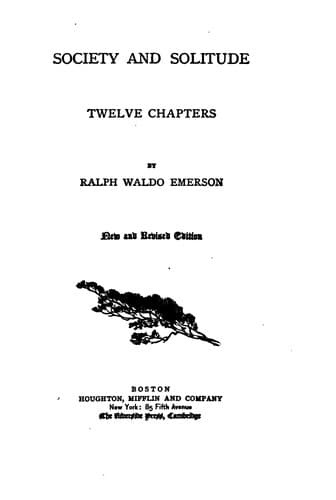
Society and solitude: Twelve chaptersEmerson, Ralph Waldo
Philosophy
Society and solitude: Twelve chapters
Emerson, Ralph Waldo
American essays -- 19th century
For if the essence of age is not present, these signs, whether of Art
or Nature, are counterfeit and ridiculous: and the essence of age is
intellect. Wherever that appears, we call it old. If we look into the
eyes of the youngest person, we sometimes discover that here is one who
knows already what you would go about with much pains to teach him;
there is that in him which is the ancestor of all around him: which
fact the Indian Vedas express when they say, “He that can discriminate
is the father of his father.” And in our old British legends of Arthur
and the Round Table, his friend and counsellor, Merlin the Wise, is a
babe found exposed in a basket by the river-side, and, though an infant
of only a few days, speaks articulately to those who discover him,
tells his name and history, and presently foretells the fate of the
by-standers. Wherever there is power, there is age. Don’t be deceived
by dimples and curls. I tell you that babe is a thousand years old.
Time is, indeed, the theatre and seat of illusion: nothing is so
ductile and elastic. The mind stretches an hour to a century, and
dwarfs an age to an hour. Saadi found in a mosque at Damascus an old
Persian of a hundred and fifty years who was dying, and was saying to
himself, “I said, coming into the world by birth, ‘I will enjoy myself
for a few moments.’ Alas! at the variegated table of life I partook
of a few mouthfuls, and the Fates said, ‘_Enough!_’” That which does
not decay is so central and controlling in us, that, as long as one
is alone by himself, he is not sensible of the inroads of time, which
always begin at the surface-edges. If, on a winter day, you should
stand within a bell-glass, the face and color of the afternoon clouds
would not indicate whether it were June or January; and if we did not
find the reflection of ourselves in the eyes of the young people, we
could not know that the century-clock had struck seventy instead of
twenty. How many men habitually believe that each chance passenger with
whom they converse is of their own age, and presently find it was his
father, and not his brother, whom they knew!
Public-domain text, read in full here on John Shaqi.
Reviews
Reviews
No reviews yet
Be the first to share your thoughts on this work.
Elsewhere in the archive
Join the Discussion
Join the discussion
Sign in to leave a comment or review.
Sign InorCreate an account