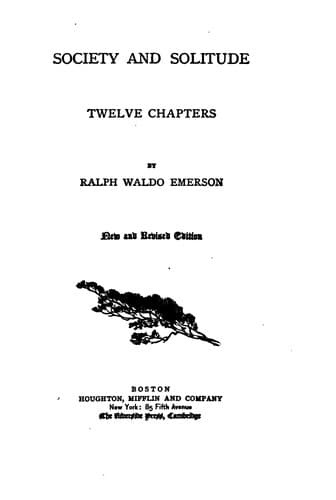
Society and solitude: Twelve chaptersEmerson, Ralph Waldo
Philosophy
Society and solitude: Twelve chapters
Emerson, Ralph Waldo
American essays -- 19th century
As, in useful art, so far as it is useful, the work must be strictly
subordinated to the laws of Nature, so as to become a sort of
continuation, and in nowise a contradiction of Nature; so, in art that
aims at beauty, must the parts be subordinated to Ideal Nature, and
everything individual abstracted, so that it shall be the production of
the universal soul.
The artist who is to produce a work which is to be admired, not by his
friends or his townspeople or his contemporaries, but by all men, and
which is to be more beautiful to the eye in proportion to its culture,
must disindividualize himself, and be a man of no party, and no manner,
and no age, but one through whom the soul of all men circulates, as the
common air through his lungs. He must work in the spirit in which we
conceive a prophet to speak, or an angel of the Lord to act; that is,
he is not to speak his own words, or do his own works, or think his own
thoughts, but he is to be an organ through which the universal mind
acts.
In speaking of the useful arts, I pointed to the fact that we do not
dig, or grind, or hew, by our muscular strength, but by bringing the
weight of the planet to bear on the spade, axe, or bar. Precisely
analogous to this, in the fine arts, is the manner of our intellectual
work. We aim to hinder our individuality from acting. So much as we
can shove aside our egotism, our prejudice, and will, and bring the
omniscience of reason upon the subject before us, so perfect is the
work. The wonders of Shakspeare are things which he saw whilst he stood
aside, and then returned to record them. The poet aims at getting
observations without aim; to subject to thought things seen without
(voluntary) thought.
In eloquence, the great triumphs of the art are, when the orator is
lifted above himself; when consciously he makes himself the mere tongue
of the occasion and the hour, and says what cannot but be said. Hence
the term _abandonment_, to describe the self-surrender of the orator.
Not his will, but the principle on which he is horsed, the great
connection and crisis of events, thunder in the ear of the crowd.
In poetry, where every word is free, every word is necessary. Good
poetry could not have been otherwise written than it is. The first time
you hear it, it sounds rather as if copied out of some invisible tablet
in the Eternal mind, than as if arbitrarily composed by the poet. The
feeling of all great poets has accorded with this. They found the
verse, not made it. The muse brought it to them.
In sculpture, did ever anybody call the Apollo a fancy piece? Or say of
the Laocoön how it might be made different? A masterpiece of art has in
the mind a fixed place in the chain of being, as much as a plant or a
crystal.
Public-domain text, read in full here on John Shaqi.
Reviews
Reviews
No reviews yet
Be the first to share your thoughts on this work.
Join the Discussion
Join the discussion
Sign in to leave a comment or review.
Sign InorCreate an account