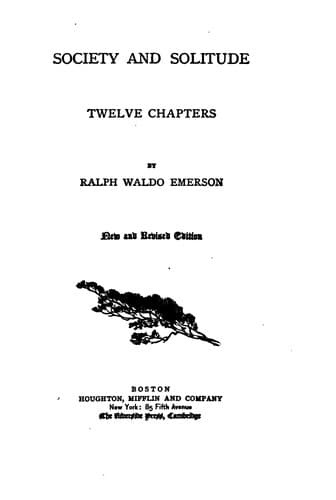
Society and solitude: Twelve chaptersEmerson, Ralph Waldo
Philosophy
Society and solitude: Twelve chapters
Emerson, Ralph Waldo
American essays -- 19th century
Arising out of eternal Reason, one and perfect, whatever is beautiful
rests on the foundation of the necessary. Nothing is arbitrary, nothing
is insulated in beauty. It depends forever on the necessary and the
useful. The plumage of the bird, the mimic plumage of the insect, has a
reason for its rich colors in the constitution of the animal. Fitness
is so inseparable an accompaniment of beauty, that it has been taken
for it. The most perfect form to answer an end is so far beautiful.
We feel, in seeing a noble building, which rhymes well, as we do in
hearing a perfect song, that it is spiritually organic; that is, had a
necessity, in nature, for being, was one of the possible forms in the
Divine mind, and is now only discovered and executed by the artist, not
arbitrarily composed by him.
And so every genuine work of art has as much reason for being as the
earth and the sun. The gayest charm of beauty has a root in the
constitution of things. The Iliad of Homer, the songs of David, the
odes of Pindar, the tragedies of Æschylus, the Doric temples, the
Gothic cathedrals, the plays of Shakspeare, all and each were made not
for sport, but in grave earnest, in tears and smiles of suffering and
loving men.
Viewed from this point, the history of Art becomes intelligible, and,
moreover, one of the most agreeable studies. We see how each work of
art sprang irresistibly from necessity, and, moreover, took its form
from the broad hint of Nature. Beautiful in this wise is the obvious
origin of all the known orders of architecture; namely, that they
were the idealizing of the primitive abodes of each people. There
was no wilfulness in the savages in this perpetuating of their first
rude abodes. The first form in which they built a house would be the
first form of their public and religious edifice also. This form
becomes immediately sacred in the eyes of their children, and, as more
traditions cluster round it, is imitated with more splendor in each
succeeding generation.
Public-domain text, read in full here on John Shaqi.
Reviews
Reviews
No reviews yet
Be the first to share your thoughts on this work.
Join the Discussion
Join the discussion
Sign in to leave a comment or review.
Sign InorCreate an account