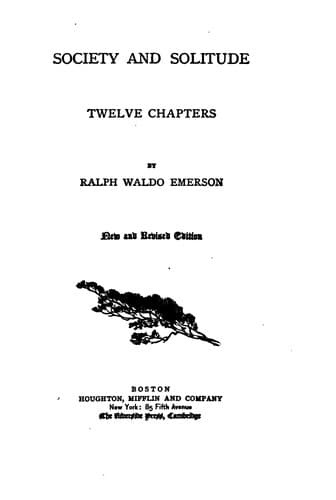
Society and solitude: Twelve chapters — John Shaqi
Society and solitude: Twelve chaptersEmerson, Ralph Waldo
Philosophy
Society and solitude: Twelve chapters
Emerson, Ralph Waldo
American essays -- 19th century
In this country, at this time, other interests than religion and
patriotism are predominant, and the arts, the daughters of enthusiasm,
do not flourish. The genuine offspring of our ruling passions we
behold. Popular institutions, the school, the reading-room, the
telegraph, the post-office, the exchange, the insurance-company, and
the immense harvest of economical inventions, are the fruit of the
equality and the boundless liberty of lucrative callings. These are
superficial wants; and their fruits are these superficial institutions.
But as far as they accelerate the end of political freedom and
national education, they are preparing the soil of man for fairer
flowers and fruits in another age. For beauty, truth, and goodness
are not obsolete; they spring eternal in the breast of man; they are
as indigenous in Massachusetts as in Tuscany or the Isles of Greece.
And that Eternal Spirit, whose triple face they are, moulds from them
forever, for his mortal child, images to remind him of the Infinite and
Fair.
ELOQUENCE.
ELOQUENCE.
It is the doctrine of the popular music-masters, that whoever can
speak can sing. So, probably, every man is eloquent once in his life.
Our temperaments differ in capacity of heat, or, we boil at different
degrees. One man is brought to the boiling-point by the excitement of
conversation in the parlor. The waters, of course, are not very deep.
He has a two-inch enthusiasm, a patty-pan ebullition. Another requires
the additional caloric of a multitude, and a public debate; a third
needs an antagonist, or a hot indignation; a fourth needs a revolution;
and a fifth, nothing less than the grandeur of absolute ideas, the
splendors and shades of Heaven and Hell.
But because every man is an orator, how long soever he may have been
a mute, an assembly of men is so much more susceptible. The eloquence
of one stimulates all the rest, some up to the speaking-point, and
all others to a degree that makes them good receivers and conductors,
and they avenge themselves for their enforced silence by increased
loquacity on their return to the fireside.
The plight of these phlegmatic brains is better than that of those
who prematurely boil, and who impatiently break silence before their
time. Our county conventions often exhibit a small-pot-soon-hot style
of eloquence. We are too much reminded of a medical experiment where a
series of patients are taking nitrous-oxide gas. Each patient, in turn,
exhibits similar symptoms,--redness in the face, volubility, violent
gesticulation, delirious attitudes, occasional stamping, an alarming
loss of perception of the passage of time, a selfish enjoyment of his
sensations, and loss of perception of the sufferings of the audience.
Public-domain text, read in full here on John Shaqi.
Reviews
Reviews
No reviews yet
Be the first to share your thoughts on this work.
Join the Discussion
Join the discussion
Sign in to leave a comment or review.
Sign InorCreate an account