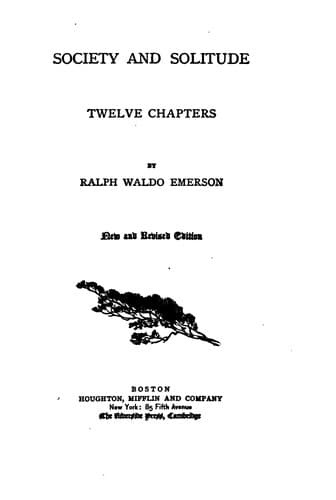
Society and solitude: Twelve chaptersEmerson, Ralph Waldo
Philosophy
Society and solitude: Twelve chapters
Emerson, Ralph Waldo
American essays -- 19th century
One of our statesmen said, “The curse of this country is eloquent men.”
And one cannot wonder at the uneasiness sometimes manifested by trained
statesmen, with large experience of public affairs, when they observe
the disproportionate advantage suddenly given to oratory over the most
solid and accumulated public service. In a Senate or other business
committee, the solid result depends on a few men with working-talent.
They know how to deal with the facts before them, to put things into a
practical shape, and they value men only as they can forward the work.
But a new man comes there, who has no capacity for helping them at all,
is insignificant, and nobody in the committee, but has a talent for
speaking. In the debate with open doors, this precious person makes a
speech, which is printed, and read all over the Union, and he at once
becomes famous, and takes the lead in the public mind over all these
executive men, who, of course, are full of indignation to find one who
has no tact or skill, and knows he has none, put over them by means of
this talking-power which they despise.
Leaving behind us these pretensions, better or worse, to come a little
nearer to the verity,--eloquence is attractive as an example of the
magic of personal ascendency,--a total and resultant power, rare,
because it requires a rich coincidence of powers, intellect, will,
sympathy, organs, and, over all, good fortune in the cause. We have
a half-belief that the person is possible who can counterpoise all
other persons. We believe that there may be a man who is a match for
events,--one who never found his match,--against whom other men being
dashed are broken,--one of inexhaustible personal resources, who can
give you any odds and beat you. What we really wish for is a mind
equal to any exigency. You are safe in your rural district, or in the
city, in broad daylight, amidst the police, and under the eyes of a
hundred thousand people. But how is it on the Atlantic, in a storm,--do
you understand how to infuse your reason into men disabled by terror,
and to bring yourself off safe then?--how among thieves, or among an
infuriated populace, or among cannibals? Face to face with a highwayman
who has every temptation and opportunity for violence and plunder, can
you bring yourself off safe by your wit, exercised through speech?--a
problem easy enough to Cæsar or Napoleon. Whenever a man of that
stamp arrives, the highwayman has found a master. What a difference
between men in power of face! A man succeeds because he has more power
of eye than another, and so coaxes or confounds him. The newspapers,
every week, report the adventures of some impudent swindler, who, by
steadiness of carriage, duped those who should have known better. Yet
any swindlers we have known are novices and bunglers, as is attested
by their ill name. A greater power of face would accomplish anything,
and, with the rest of their takings, take away the bad name. A greater
Public-domain text, read in full here on John Shaqi.
Reviews
Reviews
No reviews yet
Be the first to share your thoughts on this work.
Join the Discussion
Join the discussion
Sign in to leave a comment or review.
Sign InorCreate an account