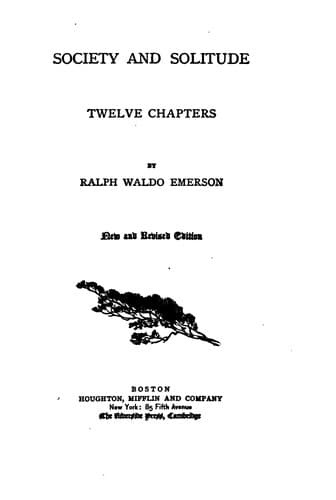
Society and solitude: Twelve chaptersEmerson, Ralph Waldo
Philosophy
Society and solitude: Twelve chapters
Emerson, Ralph Waldo
American essays -- 19th century
Why need I speak of steam, the enemy of space and time, with its
enormous strength and delicate applicability, which is made in
hospitals to bring a bowl of gruel to a sick man’s bed, and can twist
beams of iron like candy-braids, and vies with the forces which
upheaved and doubled over the geologic strata? Steam is an apt scholar
and a strong-shouldered fellow, but it has not yet done all its work.
It already walks about the field like a man, and will do anything
required of it. It irrigates crops, and drags away a mountain. It
must sew our shirts, it must drive our gigs; taught by Mr. Babbage,
it must calculate interest and logarithms. Lord Chancellor Thurlow
thought it might be made to draw bills and answers in chancery. If
that were satire, it is yet coming to render many higher services of
a mechanico-intellectual kind, and will leave the satire short of the
fact.
How excellent are the mechanical aids we have applied to the human
body, as in dentistry, in vaccination, in the rhinoplastic treatment;
in the beautiful aid of ether, like a finer sleep; and in the boldest
promiser of all,--the transfusion of the blood,--which, in Paris, it
was claimed, enables a man to change his blood as often as his linen!
What of this dapper caoutchouc and gutta-percha, which make water-pipes
and stomach-pumps, belting for mill-wheels, and diving bells, and
rain-proof coats for all climates, which teach us to defy the wet,
and put every man on a footing with the beaver and the crocodile?
What of the grand tools with which we engineer, like kobolds and
enchanters,--tunnelling Alps, canalling the American Isthmus, piercing
the Arabian desert? In Massachusetts, we fight the sea successfully
with beach-grass and broom,--and the blowing sand-barrens with pine
plantations. The soil of Holland, once the most populous in Europe,
is below the level of the sea. Egypt, where no rain fell for three
thousand years, now, it is said, thanks Mehemet Ali’s irrigations and
planted forests for late-returning showers. The old Hebrew king said,
“He makes the wrath of man to praise him.” And there is no argument of
theism better than the grandeur of ends brought about by paltry means.
The chain of western railroads from Chicago to the Pacific has planted
cities and civilization in less time than it costs to bring an orchard
into bearing.
What shall we say of the ocean telegraph, that extension of the eye and
ear, whose sudden performance astonished mankind as if the intellect
were taking the brute earth itself into training, and shooting the
first thrills of life and thought through the unwilling brain?
There does not seem any limit to these new informations of the same
Spirit that made the elements at first, and now, through man, works
them. Art and power will go on as they have done,--will make day out
of night, time out of space, and space out of time.
Public-domain text, read in full here on John Shaqi.
Reviews
Reviews
No reviews yet
Be the first to share your thoughts on this work.
Elsewhere in the archive
Join the Discussion
Join the discussion
Sign in to leave a comment or review.
Sign InorCreate an account