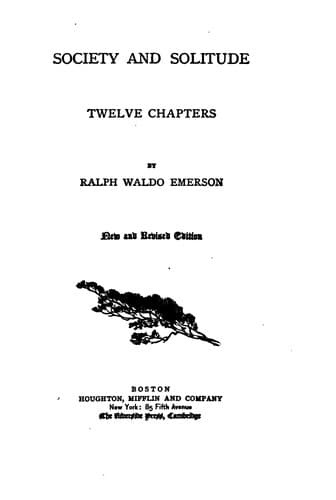
Society and solitude: Twelve chaptersEmerson, Ralph Waldo
Philosophy
Society and solitude: Twelve chapters
Emerson, Ralph Waldo
American essays -- 19th century
Invention breeds invention. No sooner is the electric telegraph
devised, than gutta-percha, the very material it requires, is found.
The aeronaut is provided with gun-cotton, the very fuel he wants for
his balloon. When commerce is vastly enlarged, California and Australia
expose the gold it needs. When Europe is over-populated, America and
Australia crave to be peopled; and so, throughout, every chance is
timed, as if Nature, who made the lock, knew where to find the key.
Another result of our arts is the new intercourse which is surprising
us with new solutions of the embarrassing political problems. The
intercourse is not new, but the scale is new. Our selfishness would
have held slaves, or would have excluded from a quarter of the planet
all that are not born on the soil of that quarter. Our politics are
disgusting; but what can they help or hinder when from time to time
the primal instincts are impressed on masses of mankind, when the
nations are in exodus and flux? Nature loves to cross her stocks,--and
German, Chinese, Turk, Russ, and Kanaka were putting out to sea, and
intermarrying race with race; and commerce took the hint, and ships
were built capacious enough to carry the people of a county.
This thousand-handed art has introduced a new element into the state.
The science of power is forced to remember the power of science.
Civilization mounts and climbs. Malthus, when he stated that the mouths
went on multiplying geometrically, and the food only arithmetically,
forgot to say that the human mind was also a factor in political
economy, and that the augmenting wants of society would be met by an
augmenting power of invention.
Yes, we have a pretty artillery of tools now in our social
arrangements: we ride four times as fast as our fathers did; travel,
grind, weave, forge, plant, till, and excavate better. We have new
shoes, gloves, glasses, and gimlets; we have the calculus; we have the
newspaper, which does its best to make every square acre of land and
sea give an account of itself at your breakfast-table; we have money,
and paper money; we have language,--the finest tool of all, and nearest
to the mind. Much will have more. Man flatters himself that his command
over nature must increase. Things begin to obey him. We are to have the
balloon yet, and the next war will be fought in the air. We may yet
find a rose-water that will wash the negro white. He sees the skull of
the English race changing from its Saxon type under the exigencies of
American life.
Public-domain text, read in full here on John Shaqi.
Reviews
Reviews
No reviews yet
Be the first to share your thoughts on this work.
Elsewhere in the archive
Join the Discussion
Join the discussion
Sign in to leave a comment or review.
Sign InorCreate an account