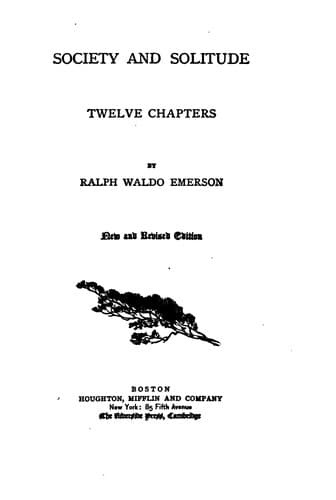
Society and solitude: Twelve chaptersEmerson, Ralph Waldo
Philosophy
Society and solitude: Twelve chapters
Emerson, Ralph Waldo
American essays -- 19th century
Of course, we resort to the enumeration of his arts and inventions as a
measure of the worth of man. But if, with all his arts, he is a felon,
we cannot assume the mechanical skill or chemical resources as the
measure of worth. Let us try another gauge.
What have these arts done for the character, for the worth of mankind?
Are men better? ’Tis sometimes questioned whether morals have not
declined as the arts have ascended. Here are great arts and little men.
Here is greatness begotten of paltriness. We cannot trace the triumphs
of civilization to such benefactors as we wish. The greatest meliorator
of the world is selfish, huckstering Trade. Every victory over matter
ought to recommend to man the worth of his nature. But now one wonders
who did all this good. Look up the inventors. Each has his own knack;
his genius is in veins and spots. But the great, equal, symmetrical
brain, fed from a great heart, you shall not find. Every one has more
to hide than he has to show, or is lamed by his excellence. ’Tis too
plain that with the material power the moral progress has not kept
pace. It appears that we have not made a judicious investment. Works
and days were offered us, and we took works.
The new study of the Sanskrit has shown us the origin of the old names
of God,--Dyaus, Deus, Zeus, Zeu pater, Jupiter,--names of the sun,
still recognizable through the modifications of our vernacular words,
importing that the Day is the Divine Power and Manifestation, and
indicating that those ancient men, in their attempts to express the
Supreme Power of the universe, called him the Day, and that this name
was accepted by all the tribes.
Hesiod wrote a poem which he called “Works and Days,” in which he
marked the changes of the Greek year, instructing the husbandman at
the rising of what constellation he might safely sow, when to reap,
when to gather wood, when the sailor might launch his boat in security
from storms, and what admonitions of the planets he must heed. It is
full of economies for Grecian life, noting the proper age for marriage,
the rules of household thrift, and of hospitality. The poem is full of
piety as well as prudence, and is adapted to all meridians, by adding
the ethics of works and of days. But he has not pushed his study of
days into such inquiry and analysis as they invite.
Public-domain text, read in full here on John Shaqi.
Reviews
Reviews
No reviews yet
Be the first to share your thoughts on this work.
Elsewhere in the archive
Join the Discussion
Join the discussion
Sign in to leave a comment or review.
Sign InorCreate an account