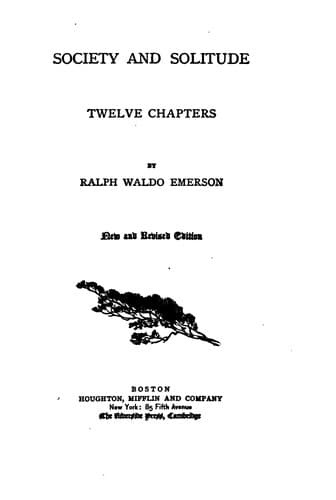
Society and solitude: Twelve chaptersEmerson, Ralph Waldo
Philosophy
Society and solitude: Twelve chapters
Emerson, Ralph Waldo
American essays -- 19th century
A farmer said “he should like to have all the land that joined his
own.” Bonaparte, who had the same appetite, endeavored to make the
Mediterranean a French lake. Czar Alexander was more expansive, and
wished to call the Pacific _my ocean_; and the Americans were obliged
to resist his attempts to make it a close sea. But if he had the earth
for his pasture, and the sea for his pond, he would be a pauper still.
He only is rich who owns the day. There is no king, rich man, fairy,
or demon who possesses such power as that. The days are ever divine
as to the first Aryans. They are of the least pretension, and of the
greatest capacity, of anything that exists. They come and go like
muffled and veiled figures, sent from a distant friendly party; but
they say nothing; and if we do not use the gifts they bring, they carry
them as silently away.
How the day fits itself to the mind, winds itself round it like a fine
drapery, clothing all its fancies! Any holiday communicates to us its
color. We wear its cockade and favors in our humor. Remember what
boys think in the morning of “Election day,” of the Fourth of July,
of Thanksgiving or Christmas. The very stars in their courses wink
to them of nuts and cakes, bonbons, presents, and fireworks. Cannot
memory still descry the old school-house and its porch, somewhat hacked
by jack-knives, where you spun tops and snapped marbles; and do you
not recall that life was then calendared by moments, threw itself
into nervous knots or glittering hours, even as now, and not spread
itself abroad an equable felicity? In college terms, and in years
that followed, the young graduate, when the Commencement anniversary
returned, though he were in a swamp, would see a festive light, and
find the air faintly echoing with plausive academic thunders. In
solitude and in the country, what dignity distinguishes the holy time!
The old Sabbath, or Seventh Day, white with the religions of unknown
thousands of years, when this hallowed hour dawns out of the deep,--a
clean page, which the wise may inscribe with truth, whilst the savage
scrawls it with fetishes,--the cathedral music of history breathes
through it a psalm to our solitude.
So, in the common experience of the scholar, the weathers fit his
moods. A thousand tunes the variable wind plays, a thousand spectacles
it brings, and each is the frame or dwelling of a new spirit. I used
formerly to choose my time with some nicety for each favorite book.
One author is good for winter, and one for the dog-days. The scholar
must look long for the right hour for Plato’s Timæus. At last the elect
morning arrives, the early dawn,--a few lights conspicuous in the
heaven, as of a world just created and still becoming,--and in its wide
leisures we dare open that book.
Public-domain text, read in full here on John Shaqi.
Reviews
Reviews
No reviews yet
Be the first to share your thoughts on this work.
Elsewhere in the archive
Join the Discussion
Join the discussion
Sign in to leave a comment or review.
Sign InorCreate an account