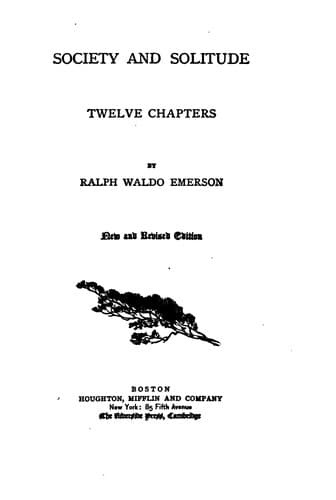
Society and solitude: Twelve chaptersEmerson, Ralph Waldo
Philosophy
Society and solitude: Twelve chapters
Emerson, Ralph Waldo
American essays -- 19th century
highest heaven of wisdom is alike near from every point, and thou must
find it, if at all, by methods native to thyself alone.
That work is ever the more pleasant to the imagination which is not now
required. How wistfully, when we have promised to attend the working
committee, we look at the distant hills and their seductions!
The use of history is to give value to the present hour and its duty.
That is good which commends to me my country, my climate, my means
and materials, my associates. I knew a man in a certain religious
exaltation, who “thought it an honor to wash his own face.” He seemed
to me more sane than those who hold themselves cheap.
Zoölogists may deny that horse-hairs in the water change to worms; but
I find that whatever is old corrupts, and the past turns to snakes. The
reverence for the deeds of our ancestors is a treacherous sentiment.
Their merit was not to reverence the old, but to honor the present
moment; and we falsely make them excuses of the very habit which they
hated and defied.
Another illusion is, that there is not time enough for our work. Yet
we might reflect that though many creatures eat from one dish, each,
according to its constitution, assimilates from the elements what
belongs to it, whether time, or space, or light, or water, or food. A
snake converts whatever prey the meadow yields him into snake; a fox,
into fox; and Peter and John are working up all existence into Peter
and John. A poor Indian chief of the Six Nations of New York made a
wiser reply than any philosopher, to some one complaining that he had
not enough time. “Well,” said Red Jacket, “I suppose you have all there
is.”
A third illusion haunts us, that a long duration, as a year, a decade,
a century, is valuable. But an old French sentence says, “God works
in moments,”--“_En peu d’heure Dieu labeure_.” We ask for long life,
but ’tis deep life, or grand moments, that signify. Let the measure of
time be spiritual, not mechanical. Life is unnecessarily long. Moments
of insight, of fine personal relation, a smile, a glance,--what ample
borrowers of eternity they are! Life culminates and concentrates; and
Homer said, “The gods ever give to mortals their apportioned share of
reason only on one day.”
I am of the opinion of the poet Wordsworth, “that there is no real
happiness in this life, but in intellect and virtue.” I am of the
opinion of Pliny, “that, whilst we are musing on these things, we are
adding to the length of our lives.” I am of the opinion of Glauco, who
said, “The measure of life, O Socrates, is, with the wise, the speaking
and hearing such discourses as yours.”
Public-domain text, read in full here on John Shaqi.
Reviews
Reviews
No reviews yet
Be the first to share your thoughts on this work.
Elsewhere in the archive
Join the Discussion
Join the discussion
Sign in to leave a comment or review.
Sign InorCreate an account