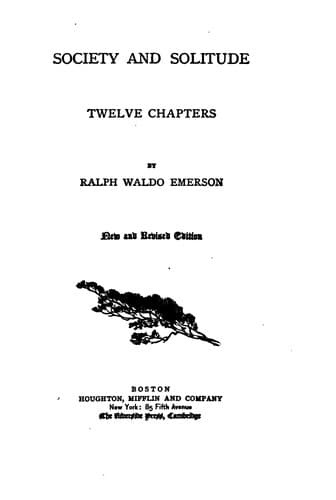
Society and solitude: Twelve chaptersEmerson, Ralph Waldo
Philosophy
Society and solitude: Twelve chapters
Emerson, Ralph Waldo
American essays -- 19th century
He only can enrich me who can recommend to me the space between sun
and sun. ’Tis the measure of a man,--his apprehension of a day. For
we do not listen with the best regard to the verses of a man who is
only a poet, nor to his problems, if he is only an algebraist; but if
a man is at once acquainted with the geometric foundations of things
and with their festal splendor, his poetry is exact and his arithmetic
musical. And him I reckon the most learned scholar, not who can unearth
for me the buried dynasties of Sesostris and Ptolemy, the Sothiac era,
the Olympiads and consulships, but who can unfold the theory of this
particular Wednesday. Can he uncover the ligaments concealed from
all but piety, which attach the dull men and things we know to the
First Cause? These passing fifteen minutes, men think, are time, not
eternity; are low and subaltern, are but hope or memory, that is, the
way _to_ or the way _from_ welfare, but not welfare. Can he show their
tie? That interpreter shall guide us from a menial and eleemosynary
existence into riches and stability. He dignifies the place where he
is. This mendicant America, this curious, peering, itinerant, imitative
America, studious of Greece and Rome, of England and Germany, will
take off its dusty shoes, will take off its glazed traveller’s-cap,
and sit at home with repose and deep joy on its face. The world has no
such landscape, the aeons of history no such hour, the future no equal
second opportunity. Now let poets sing! now let arts unfold!
One more view remains. But life is good only when it is magical and
musical, a perfect timing and consent, and when we do not anatomize
it. You must treat the days respectfully, you must be a day yourself,
and not interrogate it like a college professor. The world is
enigmatical,--everything said, and everything known or done,--and must
not be taken literally, but genially. We must be at the top of our
condition to understand anything rightly. You must hear the bird’s
song without attempting to render it into nouns and verbs. Cannot we be
a little abstemious and obedient? Cannot we let the morning be?
Public-domain text, read in full here on John Shaqi.
Reviews
Reviews
No reviews yet
Be the first to share your thoughts on this work.
Elsewhere in the archive
Join the Discussion
Join the discussion
Sign in to leave a comment or review.
Sign InorCreate an account