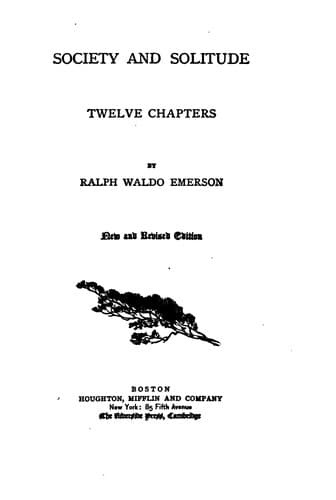
Society and solitude: Twelve chaptersEmerson, Ralph Waldo
Philosophy
Society and solitude: Twelve chapters
Emerson, Ralph Waldo
American essays -- 19th century
Everything in the universe goes by indirection. There are no straight
lines. I remember well the foreign scholar who made a week of my youth
happy by his visit. “The savages in the islands,” he said, “delight to
play with the surf, coming in on the top of the rollers, then swimming
out again, and repeat the delicious manœuvre for hours. Well, human
life is made up of such transits. There can be no greatness without
abandonment. But here your very astronomy is an espionage. I dare not
go out of doors and see the moon and stars, but they seem to measure
my tasks, to ask how many lines or pages are finished since I saw them
last. Not so, as I told you, was it in Belleisle. The days at Belleisle
were all different, and only joined by a perfect love of the same
object. Just to fill the hour,--that is happiness. Fill my hour, ye
gods, so that I shall not say, whilst I have done this, ‘Behold, also,
an hour of my life is gone,’--but rather, ‘I have lived an hour.’”
We do not want factitious men, who can do any literary or professional
feat, as, to write poems, or advocate a cause, or carry a measure, for
money; or turn their ability indifferently in any particular direction
by the strong effort of will. No, what has been best done in the
world,--the works of genius,--cost nothing. There is no painful effort,
but it is the spontaneous flowing of the thought. Shakspeare made his
Hamlet as a bird weaves its nest. Poems have been written between
sleeping and waking, irresponsibly. Fancy defines herself:
“Forms that men spy
With the half-shut eye
In the beams of the setting sun, am I.”
The masters painted for joy, and knew not that virtue had gone out
of them. They could not paint the like in cold blood. The masters of
English lyric wrote their songs so. It was a fine efflorescence of fine
powers; as was said of the letters of the Frenchwomen,--“the charming
accident of their more charming existence.” Then the poet is never the
poorer for his song. A song is no song unless the circumstance is free
and fine. If the singer sing from a sense of duty or from seeing no
way of escape, I had rather have none. Those only can sleep who do not
care to sleep; and those only write or speak best who do not too much
respect the writing or the speaking.
Public-domain text, read in full here on John Shaqi.
Reviews
Reviews
No reviews yet
Be the first to share your thoughts on this work.
Elsewhere in the archive
Join the Discussion
Join the discussion
Sign in to leave a comment or review.
Sign InorCreate an account