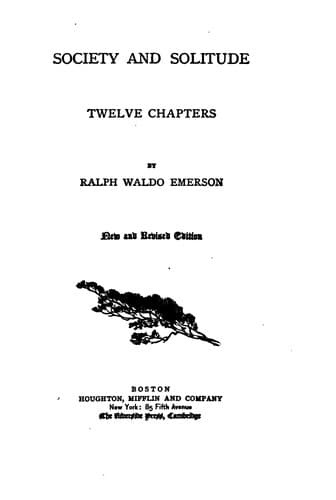
Society and solitude: Twelve chaptersEmerson, Ralph Waldo
Philosophy
Society and solitude: Twelve chapters
Emerson, Ralph Waldo
American essays -- 19th century
We owe to books those general benefits which come from high
intellectual action. Thus, I think, we often owe to them the perception
of immortality. They impart sympathetic activity to the moral power.
Go with mean people, and you think life is mean. Then read Plutarch,
and the world is a proud place, peopled with men of positive quality,
with heroes and demigods standing around us, who will not let us sleep.
Then, they address the imagination: only poetry inspires poetry.
They become the organic culture of the time. College education is the
reading of certain books which the common sense of all scholars agrees
will represent the science already accumulated. If you know that,--for
instance in geometry, if you have read Euclid and Laplace,--your
opinion has some value; if you do not know these, you are not entitled
to give any opinion on the subject. Whenever any sceptic or bigot
claims to be heard on the questions of intellect and morals, we ask if
he is familiar with the books of Plato, where all his pert objections
have once for all been disposed of. If not, he has no right to our
time. Let him go and find himself answered there.
Meantime the colleges, whilst they provide us with libraries, furnish
no professor of books; and, I think, no chair is so much wanted. In a
library we are surrounded by many hundreds of dear friends, but they
are imprisoned by an enchanter in these paper and leathern boxes;
and though they know us, and have been waiting two, ten, or twenty
centuries for us,--some of them,--and are eager to give us a sign, and
unbosom themselves, it is the law of their limbo that they must not
speak until spoken to; and as the enchanter has dressed them, like
battalions of infantry, in coat and jacket of one cut, by the thousand
and ten thousand, your chance of hitting on the right one is to be
computed by the arithmetical rule of Permutation and Combination,--not
a choice out of three caskets, but out of half a million caskets all
alike. But it happens in our experience, that in this lottery there
are at least fifty or a hundred blanks to a prize. It seems, then,
as if some charitable soul, after losing a great deal of time among
the false books, and alighting upon a few true ones which made him
happy and wise, would do a right act in naming those which have been
bridges or ships to carry him safely over dark morasses and barren
oceans, into the heart of sacred cities, into palaces and temples.
This would be best done by those great masters of books who from time
to time appear,--the Fabricii, the Seldens, Magliabecchis, Scaligers,
Mirandolas, Bayles, Johnsons, whose eyes sweep the whole horizon of
learning. But private readers, reading purely for love of the book,
would serve us by leaving each the shortest note of what he found.
Public-domain text, read in full here on John Shaqi.
Reviews
Reviews
No reviews yet
Be the first to share your thoughts on this work.
Elsewhere in the archive
Join the Discussion
Join the discussion
Sign in to leave a comment or review.
Sign InorCreate an account