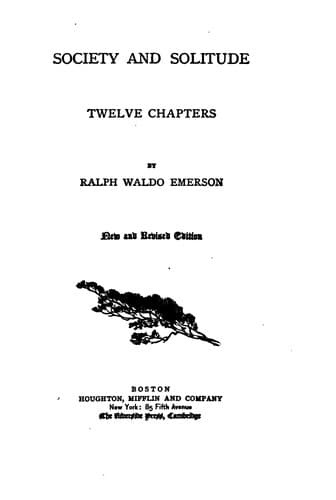
Society and solitude: Twelve chaptersEmerson, Ralph Waldo
Philosophy
Society and solitude: Twelve chapters
Emerson, Ralph Waldo
American essays -- 19th century
There are books; and it is practicable to read them, because they are
so few. We look over with a sigh the monumental libraries of Paris, of
the Vatican, and the British Museum. In 1858, the number of printed
books in the Imperial Library at Paris was estimated at eight hundred
thousand volumes, with an annual increase of twelve thousand volumes;
so that the number of printed books extant to-day may easily exceed
a million. It is easy to count the number of pages which a diligent
man can read in a day, and the number of years which human life in
favorable circumstances allows to reading; and to demonstrate, that,
though he should read from dawn till dark, for sixty years, he must
die in the first alcoves. But nothing can be more deceptive than this
arithmetic, where none but a natural method is really pertinent. I
visit occasionally the Cambridge Library, and I can seldom go there
without renewing the conviction that the best of it all is already
within the four walls of my study at home. The inspection of the
catalogue brings me continually back to the few standard writers who
are on every private shelf; and to these it can afford only the most
slight and casual additions. The crowds and centuries of books are only
commentary and elucidation, echoes and weakeners of these few great
voices of Time.
The best rule of reading will be a method from nature, and not a
mechanical one of hours and pages. It holds each student to a pursuit
of his native aim, instead of a desultory miscellany. Let him read what
is proper to him, and not waste his memory on a crowd of mediocrities.
As whole nations have derived their culture from a single book,--as the
Bible has been the literature as well as the religion of large portions
of Europe,--as Hafiz was the eminent genius of the Persians, Confucius
of the Chinese, Cervantes of the Spaniards; so, perhaps, the human mind
would be a gainer, if all the secondary writers were lost,--say, in
England, all but Shakspeare, Milton, and Bacon,--through the profounder
study so drawn to those wonderful minds. With this pilot of his own
genius, let the student read one, or let him read many, he will read
advantageously. Dr. Johnson said: “Whilst you stand deliberating
which book your son shall read first, another boy has read both: read
anything five hours a day, and you will soon be learned.”
Public-domain text, read in full here on John Shaqi.
Reviews
Reviews
No reviews yet
Be the first to share your thoughts on this work.
Elsewhere in the archive
Join the Discussion
Join the discussion
Sign in to leave a comment or review.
Sign InorCreate an account