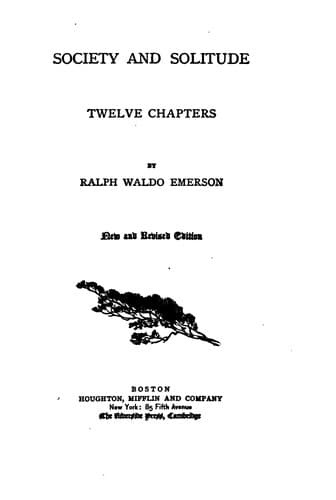
Society and solitude: Twelve chaptersEmerson, Ralph Waldo
Philosophy
Society and solitude: Twelve chapters
Emerson, Ralph Waldo
American essays -- 19th century
“Protagoras,” the “Phædrus,” the “Timæus,” the “Republic,” and the
“Apology of Socrates.” 5. Plutarch cannot be spared from the smallest
library; first, because he is so readable, which is much; then, that he
is medicinal and invigorating. The lives of Cimon, Lycurgus, Alexander,
Demosthenes, Phocion, Marcellus, and the rest, are what history has of
best. But this book has taken care of itself, and the opinion of the
world is expressed in the innumerable cheap editions, which make it
as accessible as a newspaper. But Plutarch’s “Morals” is less known,
and seldom reprinted. Yet such a reader as I am writing to can as ill
spare it as the “Lives.” He will read in it the essays “On the Dæmon
of Socrates,” “On Isis and Osiris,” “On Progress in Virtue,” “On
Garrulity,” “On Love,” and thank anew the art of printing, and the
cheerful domain of ancient thinking. Plutarch charms by the facility
of his associations; so that it signifies little where you open
his book, you find yourself at the Olympian tables. His memory is
like the Isthmian Games, where all that was excellent in Greece was
assembled, and you are stimulated and recruited by lyric verses, by
philosophic sentiments, by the forms and behavior of heroes, by the
worship of the gods, and by the passing of fillets, parsley and laurel
wreaths, chariots, armor, sacred cups, and utensils of sacrifice. An
inestimable trilogy of ancient social pictures are the three “Banquets”
respectively of Plato, Xenophon, and Plutarch. Plutarch’s has the least
approach to historical accuracy; but the meeting of the Seven Wise
Masters is a charming portraiture of ancient manners and discourse, and
is as clear as the voice of a fife, and entertaining as a French novel.
Xenophon’s delineation of Athenian manners is an accessory to Plato,
and supplies traits of Socrates; whilst Plato’s has merits of every
kind,--being a repertory of the wisdom of the ancients on the subject
of love,--a picture of a feast of wits, not less descriptive than
Aristophanes,--and, lastly, containing that ironical eulogy of Socrates
which is the source from which all the portraits of that philosopher
current in Europe have been drawn.
Public-domain text, read in full here on John Shaqi.
Reviews
Reviews
No reviews yet
Be the first to share your thoughts on this work.
Elsewhere in the archive
Join the Discussion
Join the discussion
Sign in to leave a comment or review.
Sign InorCreate an account