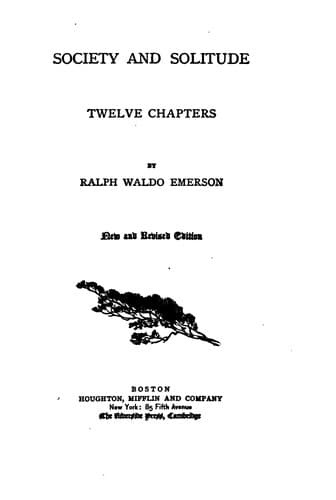
Society and solitude: Twelve chaptersEmerson, Ralph Waldo
Philosophy
Society and solitude: Twelve chapters
Emerson, Ralph Waldo
American essays -- 19th century
Of the old Greek books, I think there are five which we cannot spare:
1. Homer, who in spite of Pope and all the learned uproar of centuries,
has really the true fire, and is good for simple minds, is the true
and adequate germ of Greece, and occupies that place as history,
which nothing can supply. It holds through all literature, that our
best history is still poetry. It is so in Hebrew, in Sanskrit, and
in Greek. English history is best known through Shakspeare; how much
through Merlin, Robin Hood, and the Scottish ballads!--the German,
through the Nibelungenlied;--the Spanish, through the Cid. Of Homer,
George Chapman’s is the heroic translation, though the most literal
prose version is the best of all. 2. Herodotus, whose history contains
inestimable anecdotes, which brought it with the learned into a sort
of disesteem; but in these days, when it is found that what is most
memorable of history is a few anecdotes, and that we need not be
alarmed though we should find it not dull, it is regaining credit.
3. Æschylus, the grandest of the three tragedians, who has given us
under a thin veil the first plantation of Europe. The “Prometheus”
is a poem of the like dignity and scope as the Book of Job, or the
Norse Edda. 4. Of Plato I hesitate to speak, lest there should be no
end. You find in him that which you have already found in Homer, now
ripened to thought,--the poet converted to a philosopher, with loftier
strains of musical wisdom than Homer reached; as if Homer were the
youth, and Plato the finished man; yet with no less security of bold
and perfect song, when he cares to use it, and with some harp-strings
fetched from a higher heaven. He contains the future, as he came out
of the past. In Plato, you explore modern Europe in its causes and
seed,--all that in thought, which the history of Europe embodies or
has yet to embody. The well-informed man finds himself anticipated.
Plato is up with him too. Nothing has escaped him. Every new crop
in the fertile harvest of reform, every fresh suggestion of modern
humanity, is there. If the student wish to see both sides, and justice
done to the man of the world, pitiless exposure of pedants, and the
supremacy of truth and the religious sentiment, he shall be contented
also. Why should not young men be educated on this book? It would
suffice for the tuition of the race,--to test their understanding,
and to express their reason. Here is that which is so attractive to
all men,--the literature of aristocracy shall I call it?--the picture
of the best persons, sentiments, and manners, by the first master, in
the best times,--portraits of Pericles, Alcibiades, Crito, Prodicus,
Protagoras, Anaxagoras, and Socrates, with the lovely background of
the Athenian and suburban landscape. Or who can overestimate the
images with which Plato has enriched the minds of men, and which pass
like bullion in the currency of all nations? Read the “Phædo,” the
Public-domain text, read in full here on John Shaqi.
Reviews
Reviews
No reviews yet
Be the first to share your thoughts on this work.
Elsewhere in the archive
Join the Discussion
Join the discussion
Sign in to leave a comment or review.
Sign InorCreate an account