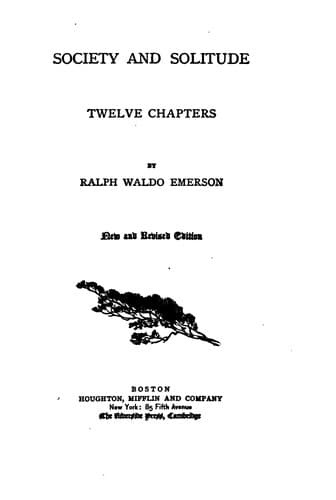
Society and solitude: Twelve chaptersEmerson, Ralph Waldo
Philosophy
Society and solitude: Twelve chapters
Emerson, Ralph Waldo
American essays -- 19th century
Another class I distinguish by the term _Vocabularies_. Burton’s
“Anatomy of Melancholy” is a book of great learning. To read it is
like reading in a dictionary. ’Tis an inventory to remind us how
many classes and species of facts exist, and, in observing into
what strange and multiplex by-ways learning has strayed, to infer
our opulence. Neither is a dictionary a bad book to read. There is
no cant in Germans, it, no excess of explanation, and it is full of
suggestion,--the raw material of possible poems and histories. Nothing
is wanting but a little shuffling, sorting, ligature, and cartilage.
Out of a hundred examples, Cornelius Agrippa “On the Vanity of Arts
and Sciences” is a specimen of that scribatiousness which grew to be
the habit of the gluttonous readers of his time. Like the modern they
read a literature while other mortals read a few books. They read
voraciously, and must disburden themselves; so they take any general
topic, as, Melancholy, or Praise of Science, or Praise of Folly,
and write and quote without method or end. Now and then out of that
affluence of their learning comes a fine sentence from Theophrastus,
or Seneca, or Boëthius, but no high method, no inspiring efflux. But
one cannot afford to read for a few sentences; they are good only as
strings of suggestive words.
There is another class, more needful to the present age, because
the currents of custom run now in another direction, and leave us
dry on this side;--I mean the _Imaginative_. A right metaphysics
should do justice to the co-ordinate powers of Imagination, Insight,
Understanding, and Will. Poetry, with its aids of Mythology and
Romance, must be well allowed for an imaginative creature. Men are
ever lapsing into a beggarly habit, wherein everything that is not
ciphering, that is, which does not serve the tyrannical animal, is
hustled out of sight. Our orators and writers are of the same poverty,
and, in this rag-fair, neither the Imagination, the great awakening
power, nor the Morals, creative of genius and of men, are addressed.
But though orator and poet be of this hunger party, the capacities
remain. We must have symbols. The child asks you for a story, and is
thankful for the poorest. It is not poor to him, but radiant with
meaning. The man asks for a novel,--that is, asks leave for a few
hours to be a poet, and to paint things as they ought to be. The youth
asks for a poem. The very dunces wish to go to the theatre. What
private heavens can we not open, by yielding to all the suggestion of
rich music! We must have idolatries, mythologies,--some swing and verge
for the creative power lying coiled and cramped here, driving ardent
natures to insanity and crime if it do not find vent. Without the great
arts which speak to the sense of beauty, a man seems to me a poor,
naked, shivering creature. These are his becoming draperies, which warm
and adorn him. Whilst the prudential and economical tone of society
Public-domain text, read in full here on John Shaqi.
Reviews
Reviews
No reviews yet
Be the first to share your thoughts on this work.
Elsewhere in the archive
Join the Discussion
Join the discussion
Sign in to leave a comment or review.
Sign InorCreate an account