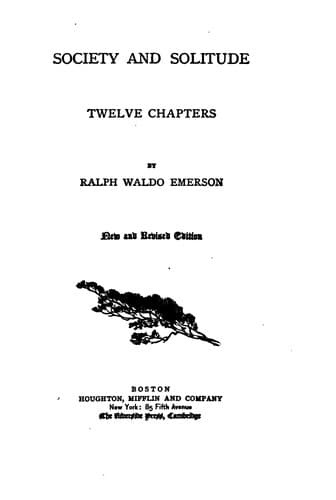
Society and solitude: Twelve chaptersEmerson, Ralph Waldo
Philosophy
Society and solitude: Twelve chapters
Emerson, Ralph Waldo
American essays -- 19th century
starves the imagination, affronted Nature gets such indemnity as she
may. The novel is that allowance and frolic the imagination finds.
Everything else pins it down, and men flee for redress to Byron, Scott,
Disraeli, Dumas, Sand, Balzac, Dickens, Thackeray, and Reade. Their
education is neglected; but the circulating-library and the theatre, as
well as the trout-fishing, the Notch Mountains, the Adirondack country,
the tour to Mont Blanc, to the White Hills, and the Ghauts, make such
amends as they can.
The imagination infuses a certain volatility and intoxication. It has a
flute which sets the atoms of our frame in a dance, like planets; and,
once so liberated, the whole man reeling drunk to the music, they never
quite subside to their old stony state. But what is the imagination?
Only an arm or weapon of the interior energy; only the precursor of
the reason. And books that treat the old pedantries of the world,
our times, places, professions, customs, opinions, histories, with a
certain freedom, and distribute things, not after the usages of America
and Europe, but after the laws of right reason, and with as daring a
freedom as we use in dreams, put us on our feet again, enable us to
form an original judgment of our duties, and suggest new thoughts for
to-morrow.
“Lucrezia Floriani,” “Le Péché de M. Antoine,” “Jeanne,” and
“Consuelo,” of George Sand, are great steps from the novel of one
termination, which we all read twenty years ago. Yet how far off from
life and manners and motives the novel still is! Life lies about us
dumb; the day, as we know it, has not yet found a tongue. These stories
are to the plots of real life what the figures in “La Belle Assemblée,”
which represent the fashion of the month, are to portraits. But the
novel will find the way to our interiors one day, and will not always
be the novel of costume merely. I do not think it inoperative now. So
much novel-reading cannot leave the young men and maidens untouched;
and doubtless it gives some ideal dignity to the day. The young study
noble behavior; and as the player in “Consuelo” insists that he and his
colleagues on the boards have taught princes the fine etiquette and
strokes of grace and dignity which they practise with so much effect
in their villas and among their dependents, so I often see traces
of the Scotch or the French novel in the courtesy and brilliancy of
young midshipmen, collegians, and clerks. Indeed, when one observes
how ill and ugly people make their loves and quarrels, ’tis pity they
should not read novels a little more, to import the fine generosities,
and the clear, firm conduct, which are as becoming in the unions and
separations which love effects under shingle roofs as in palaces and
among illustrious personages.
Public-domain text, read in full here on John Shaqi.
Reviews
Reviews
No reviews yet
Be the first to share your thoughts on this work.
Elsewhere in the archive
Join the Discussion
Join the discussion
Sign in to leave a comment or review.
Sign InorCreate an account