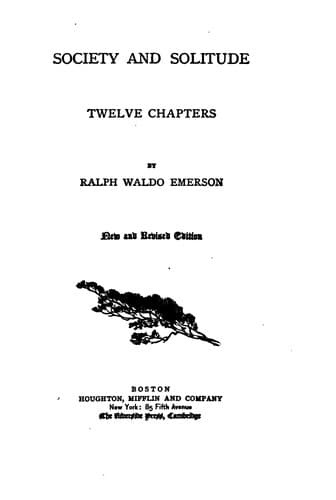
Society and solitude: Twelve chaptersEmerson, Ralph Waldo
Philosophy
Society and solitude: Twelve chapters
Emerson, Ralph Waldo
American essays -- 19th century
In novels the most serious questions are beginning to be discussed.
What made the popularity of “Jane Eyre,” but that a central question
was answered in some sort? The question there answered in regard to a
vicious marriage will always be treated according to the habit of the
party. A person of commanding individualism will answer it as Rochester
does,--as Cleopatra, as Milton, as George Sand do,--magnifying the
exception into a rule, dwarfing the world into an exception. A person
of less courage, that is, of less constitution, will answer as the
heroine does,--giving way to fate, to conventionalism, to the actual
state and doings of men and women.
For the most part, our novel-reading is a passion for results. We
admire parks, and high-born beauties, and the homage of drawing-rooms,
and parliaments. They make us sceptical, by giving prominence to
wealth and social position.
I remember when some peering eyes of boys discovered that the oranges
hanging on the boughs of an orange-tree in a gay piazza were tied to
the twigs by thread. I fear ’tis so with the novelist’s prosperities.
Nature has a magic by which she fits the man to his fortunes, by
making them the fruit of his character. But the novelist plucks this
event here, and that fortune there, and ties them rashly to his
figures, to tickle the fancy of his readers with a cloying success,
or scare them with shocks of tragedy. And so, on the whole, ’tis a
juggle. We are cheated into laughter or wonder by feats which only
oddly combine acts that we do every day. There is no new element, no
power, no furtherance. ’Tis only confectionery, not the raising of new
corn. Great is the poverty of their inventions. _She was beautiful,
and he fell in love._ Money, and killing, and the Wandering Jew, and
persuading the lover that his mistress is betrothed to another,--these
are the main-springs: new names, but no new qualities in the men and
women. Hence the vain endeavor to keep any bit of this fairy gold,
which has rolled like a brook through our hands. A thousand thoughts
awoke; great rainbows seemed to span the sky,--a morning among the
mountains;--but we close the book, and not a ray remains in the memory
of evening. But this passion for romance, and this disappointment,
show how much we need real elevations and pure poetry: that which shall
show us, in morning and night, in stars and mountains, and in all the
plight and circumstance of men, the analogons of our own thoughts, and
a like impression made by a just book and by the face of Nature.
Public-domain text, read in full here on John Shaqi.
Reviews
Reviews
No reviews yet
Be the first to share your thoughts on this work.
Elsewhere in the archive
Join the Discussion
Join the discussion
Sign in to leave a comment or review.
Sign InorCreate an account