Soissons (France) -- Guidebooks; Soissons (France) -- History
SCALE: 1: 200.000
(3·15 miles to the inch).
On sale at Michelin stockists and booksellers.
The tourist finds his way about easily =in town=, if he has a plan
giving the names of the streets.
He gets about with the same ease and certainty =on the road=, if he
has a =Michelin map=, because it gives all the road numbers on the
milestones and road-signs.
[Illustration]
=The “Michelin Wheel”=
BEST of all detachable wheels because the least complicated
_Elegant_
It embellishes even the finest coachwork.
_Simple_
It is detachable at the hub and fixed by six bolts only.
_Strong_
The only wheel which held out on all fronts during the War.
_Practical_
Can be replaced in 3 minutes by =anybody= and cleaned still quicker.
It prolongs the life of tyres by cooling them.
=AND THE CHEAPEST=
[Illustration]
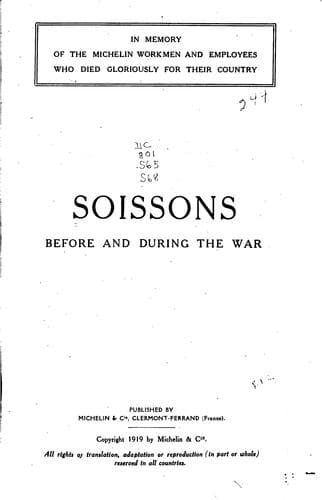
IN MEMORY OF THE MICHELIN WORKMEN AND EMPLOYEES WHO DIED GLORIOUSLY FOR
THEIR COUNTRY
SOISSONS
BEFORE AND DURING THE WAR
PUBLISHED BY MICHELIN & C^{ie}, CLERMONT-FERRAND (France).
Copyright 1919 by Michelin & C^{ie}.
_All rights of translation, adaptation or reproduction (in part or
whole) reserved in all countries._
SOISSONS
ORIGIN AND CHIEF HISTORICAL EVENTS
Soissons derives its name from the _Suessiones_, a Belgian tribe who
inhabited that part of the country during the Gallic period. At that
time the City, then known as _Noviodunum_, was situated about two and
a half miles north-west of the Aisne on the Pommiers Plateau. After
Cæsar’s conquest of the country, the city was rebuilt on the banks of
the Aisne, under the name of _Augusta Suessionum_. Of the Gallo-Roman
epoch, only a small portion of the city ramparts (_p. _32) remains,
but excavations have brought to light the site of a large theatre (_p.
_51), and at the Mail, the foundations of what were luxurious villas.
The greater part of the objects unearthed are in the Museum (_p. _41),
with the exception of the famous group «Le Niobide et son Pédagogue»,
now in the Louvre.
Christianity was first preached in Soissons at the end of the 3rd
century, by two shoemakers, the brothers Crispin and Crispinian, who
suffered martyrdom there.
Soissons played an important part throughout the whole of the Frankish
Monarchy. It was at its gates that in 486, Clovis won a decisive
victory over the last Roman Count, _Syagrius_, thus causing the
downfall of Roman domination in Gaul. It was after this victory that
the famous episode of the Soissons Vase occurred.
The Frankish King lived for a long time in the city, and at his death
in 511, Soissons became the capital of the kingdom of one of his sons,
_Clotaire I_, who ultimately became sole king of the Franks. Later,
Soissons once more became a separate kingdom under _Chilperic_, and
again under _Clotaire II_ (561–613). During this period, the rivalry
of _Brunehaut_ and _Frédégonde_ gave rise to sanguinary episodes in
Soissons and the surrounding country.
Public-domain text, read in full here on John Shaqi.
Reviews
Reviews
No reviews yet
Be the first to share your thoughts on this work.
Join the Discussion
Join the discussion
Sign in to leave a comment or review.
Sign InorCreate an account