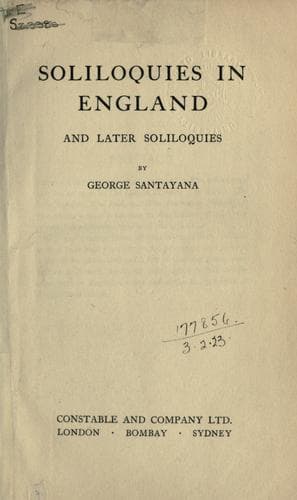
Soliloquies in England, and Later SoliloquiesSantayana, George
Philosophy
Soliloquies in England, and Later Soliloquies
Santayana, George
American essays -- 20th century
spirit springs, are like the conjunctions or eclipses of planets, facts
obvious enough to sense in their specious simplicity, yet materially
only momentary positions of transit for wayfarers bound each on his own
errand. The songs of larks are like shooting stars that drop downwards
and vanish; human intelligence is a part of the steadier music of the
spheres.
27
AT HEAVEN'S GATE
Skylarks, if they exist elsewhere, must be homesick for England. They
need these kindly mists to hide and to sustain them. Their flexible
throats would soon be parched, far from these vaporous meadows and
hedgerows rich in berries and loam. How should they live in arid
tablelands, or at merciless altitudes, where there is nothing but
scorching heat or a freezing blizzard? What space could they find
for solitude and freedom in the tangle of tropical forests, amongst
the monkeys and parrots? What reserve, what tenderness, what inward
springs of happiness could they treasure amid those gross harlot-like
flowers? No, they are the hermits of this mild atmosphere, fled to
its wilderness of gentle light. Well may they leave it to eagles to
rush against the naked sun, as if its round eye challenged them to
single combat: not theirs the stupid ferocity of passion against fact,
anger against light, swiftness against poise, beak and talons against
intangible fire. Larks may not be very clever, but they are not so
foolish as to be proud, or to scream hoarsely against the nature of
things. Having wings and voluble throats they play with them for pure
pleasure; they are little artists and little gentlemen; they disdain
to employ their faculties for their mere utility, or only in order to
pounce down to the earth, whenever they spy a dainty morsel, or to
return to sulk shivering on some solitary crag, their voracity but half
appeased, like eagles dreaming of their next victim. Of course, even
the most playful songster must eat, and skylarks no doubt keep an eye
open for worms, and their nest calls them back to terrene affections;
but they are as forgetful of earth as they can be, and insatiable
craving does not stamp itself on their bent necks, as if they were
vultures, nor strain their feathers of iron. No more are they inspired
by sentimental pangs and love-sick like the nightingale; they do not
hide in the labyrinthine shade of ilex or cypress, from there to wail
in the melancholy moonlight, as it were a seductive serenade addressed
to mortal lovers. No, the trilling of larks is not for mankind. Like
English poets they sing to themselves of nature, inarticulately happy
in a bath of light and freedom, sporting for the sake of sport, turning
what doubts they may have into sweetness, not asking to see or to know
anything ulterior. They must needs drink the dew amongst these English
fields, peeping into the dark little hearts and flushed petals of
these daisies, like the heart and cheeks of an English child, or into
these buttercups, yellow like his Saxon hair.
Public-domain text, read in full here on John Shaqi.
Reviews
Reviews
No reviews yet
Be the first to share your thoughts on this work.
Elsewhere in the archive
Join the Discussion
Join the discussion
Sign in to leave a comment or review.
Sign InorCreate an account