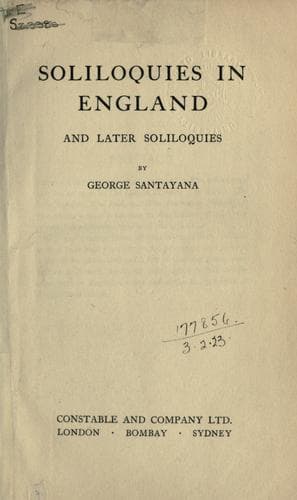
Soliloquies in England, and Later SoliloquiesSantayana, George
Philosophy
Soliloquies in England, and Later Soliloquies
Santayana, George
American essays -- 20th century
miraculously in our happy moments we understand, how far we jump, what
masses of facts we dominate at a glance! There is no labour then, no
friction or groping, no anxious jostling against what we do not know,
but only joy in this intricate outspread humorous world, intoxication
as ethereal as the lark's, but more descriptive. If his song is raised
above the world for a moment by its wantonness and idle rapture, ours
is raised above it essentially by its scope. To look before and after
is human; it would not be sincere nor manly in us not to take thought
for the morrow and not to pine for what is not. We must start on that
basis, with our human vitality (which is art) substituted for the
vegetative prayerfulness of the lily, and our human scope (which is
knowledge of the world) substituted for the outpourings of larks.
On this other plane we could easily be as happy as the larks, if we
were as liberal. Men when they are civilized and at ease are liberal
enough in their sports, and willing to _desipere in loco_, like
kittens, but it is strange how barbarous and illiberal, at least in
modern times, they have remained about thought. They wish to harness
thought like a waterfall, or like the blind Samson, to work for
them night and day, in the treadmill of their interests or of their
orthodoxy. Fie upon their stupidity and upon their slavishness! They do
not see that when nature, with much travail, brings something living
to birth, inevitable thought is there already, and gratis, and cannot
possibly be there before. The seething of the brain is indeed as
pragmatic as the habit of singing and flying, which in its inception
doubtless helped the larks to survive, as even the whiteness of the
lily may have done through the ministry of insects which it attracted;
but even material organs are bound to utility by a very loose tie.
Nature does not shake off her baroque ornaments and her vices until
they prove fatal, and she never thinks of the most obvious invention
or pressing reform, until some complication brings her, she knows
not how, to try the experiment. Nature, having no ulterior purpose,
has no need of parsimony or haste or simplicity. Much less need she
be niggardly of spirit, which lays no tax upon her, and consumes no
energy, but laughs aloud, a marvel and a mystery to her, in her very
heart. All animal functions, whether helpful or wasteful, have this
fourth dimension in the realm of spirit--the joy, or the pain, or the
beauty that may be found in them. Spirit loads with a lyric intensity
the flying moment in which it lives. It actually paints the lily
and casts a perfume on the violet; it turns into vivid presences a
thousand forms which, until its flame lighted them up, were merged in
the passive order and truth of things, like the charms of Lucy by the
springs of Dove, before Wordsworth discovered them. The smile of nature
is not ponderable; and the changing harmonies of nature, out of which
Public-domain text, read in full here on John Shaqi.
Reviews
Reviews
No reviews yet
Be the first to share your thoughts on this work.
Elsewhere in the archive
Join the Discussion
Join the discussion
Sign in to leave a comment or review.
Sign InorCreate an account