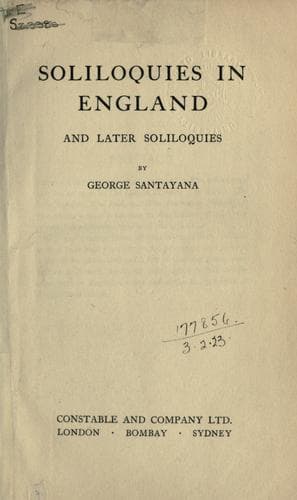
Soliloquies in England, and Later SoliloquiesSantayana, George
Philosophy
Soliloquies in England, and Later Soliloquies
Santayana, George
American essays -- 20th century
In the _Mahabharata_, a learned friend tells me, a young champion
armed for the combat and about to rush forward between the two armies
drawn up in battle array, stops for a moment to receive a word of
counsel from his spiritual adviser--and that word occupies the next
eighteen books of the epic; after which the battle is allowed to
proceed. These Indian poets had spiritual minds, they measured things
by their importance to the spirit, not to the eye. They despised
verisimilitude and aesthetic proportion; they despised existence, the
beauties of which they felt exquisitely nevertheless, and to which
their imagination made such stupendous additions. I honour their
courage in bidding the sun stand still, not that they might thoroughly
vanquish an earthly enemy, but that they might wholly clarify their own
soul. For this better purpose the sun need not stand still materially.
For the spirit, time is an elastic thing. Fancy is quick and brings
the widest vistas to a focus in a single instant. After the longest
interval of oblivion and death, it can light up the same image in all
the greenness of youth; and if cut short, as it were at Pompeii, in the
midst of a word, it can, ages after, without feeling the break, add the
last syllable. Imagination changes the scale of everything, and makes
a thousand patterns of the woof of nature, without disturbing a single
thread. Or rather--since it is nature itself that imagines--it turns
to music what was only strain; as if the universal vibration, suddenly
ashamed of having been so long silent and useless, had burst into tears
and laughter at its own folly, and in so doing had become wise.
30
THE WORLD'S A STAGE
Nature, like a theatre, offers a double object to the mind. There is
in the first place the play presented, the overt spectacle, which is
something specious and ideal; and then there is something material
and profound lying behind and only symbolically revealed, namely, the
stage, the actors, and the author. The playful spectacular sort of
reality we can pretty well dominate and exhaust, if we are attentive;
indeed the prospect, in its sensuous and poetic essence, is plastic
to attention, and alters its character according to the spectator's
station and faculty; a poetic theme develops as interest in it is
aroused, and offers different beauties and different morals to every
new critic. The instrumentalities, on the contrary, which bring
this spectacle before us, whether they be material or personal, are
unfathomable. They are events, not ideas. Even putting together all
that carpenters and chemists, biographers and psychologists, might
learn about these events, we could never probe them to the bottom.
Public-domain text, read in full here on John Shaqi.
Reviews
Reviews
No reviews yet
Be the first to share your thoughts on this work.
Elsewhere in the archive
Join the Discussion
Join the discussion
Sign in to leave a comment or review.
Sign InorCreate an account