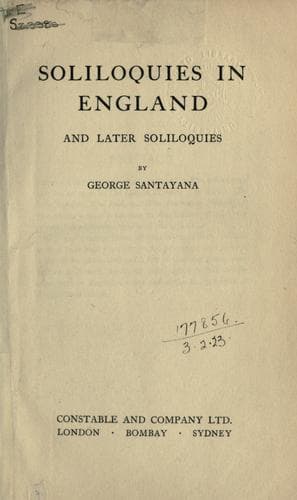
Soliloquies in England, and Later SoliloquiesSantayana, George
Philosophy
Soliloquies in England, and Later Soliloquies
Santayana, George
American essays -- 20th century
In the beginning, as for a child at his first pantomime, the play's
the thing; and a human audience can never quite outgrow this initial
illusion, since this world is a theatre nobody can visit twice. If we
could become habitués, old theatre-goers amongst the worlds, we might
grow more discriminating; on the whole we might enjoy the performances
just as much or even more, perhaps; yet less breathlessly. We should
see more and believe less. The pleasure of seeing is one, and the
pleasure of believing is quite another; the first liberates our senses
and fills the present with light; the second directs our conduct
and relieves our anxiety or doubts about the past and future. When
the spectator bethinks himself of destiny as well as of beauty, his
sensibility becomes tragic, it becomes intelligence. Every picture is
then regarded as a sign for the whole situation which has generated it
or which it forebodes. The given image, for intelligence, expresses
a problematic fact; and intelligence invents various grammatical
forms and logical categories by which to describe its hidden enemy
or fascinating prey. So spontaneous and dogmatic is the intellect in
this interpretation of the scene that the conceived object (however
abstractly sketched) is unhesitatingly judged to be, as we say, the
real thing: it alone works and acts, whilst the given image is either
disregarded altogether or despised as a mere word or phantasm of
sense, such as only fools would stop to gaze at. And it is very true,
whatever desperate efforts empiricism may make to deny it, that every
figure crossing the stage of apprehension is a symbol, or may become
a symbol; they all have some occasion and arise out of some deeper
commotion in the material world. The womb of nature is full of crowding
events, to us invisible; the ballet has machinery behind its vistas and
its music; the dancers possess a character and fate in the daylight
quite foreign to these fays and shepherds before the footlights; what
to us is a pirouette to them is a twitch or a shilling. Shame to the
impious egotism that would deny it, and, in order to spare itself the
tension of faith and the labour of understanding, would pretend to find
in experience nothing but a shadowy tapestry, a landscape without a
substance. To its invisible substance the spectacle owes not only its
existence but its meaning, since our interest in the scene is rooted
in a hidden life within us, quite as much as the shifts and colours of
the scenery are rooted in tricks of the stage. Nevertheless the roots
of things are properly and decently hidden under ground, and it is as
childish to be always pulling them up, to make sure that they exist, as
it is to deny their existence. The flowers are what chiefly interests
a man of taste; the spectacle is what liberal-minded people have come
to see. Every image has its specific aspect and aesthetic essence, more
or less charming in itself; the sensualist, the poet, the chronicler of
Public-domain text, read in full here on John Shaqi.
Reviews
Reviews
No reviews yet
Be the first to share your thoughts on this work.
Elsewhere in the archive
Join the Discussion
Join the discussion
Sign in to leave a comment or review.
Sign InorCreate an account