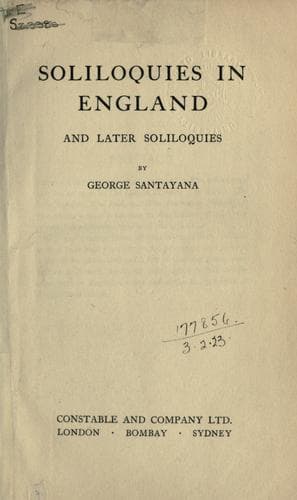
Soliloquies in England, and Later SoliloquiesSantayana, George
Philosophy
Soliloquies in England, and Later Soliloquies
Santayana, George
American essays -- 20th century
the eloquence of an imagined life; and it is intolerable to have the
game spoiled by some heavy-footed person who constantly reminds you of
the discovered facts and will not lend himself to the spirit of your
fiction, which is the deepest part of your own spirit. No one would be
angry with a man for unintentionally making a mistake about a matter
of fact; but if he perversely insists on spoiling your story in the
telling of it, you want to kick him; and this is the reason why every
philosopher and theologian is justly vexed with every other. When we
are children the accident and fatality of having been born human are
recent and only half welcome; we still feel a little hurt at being so
arbitrarily confined to one miserable career and forced to remain
always consistent; we still see the equal antecedent propriety of being
anybody or anything else. Masks afford us the pleasing excitement of
revising our so accidental birth-certificate and of changing places in
spirit with some other changeling.
Nevertheless the game soon tires. Although children are no believers in
substance, they are substances themselves without knowing it. The mask
refuses to grow on to their flesh: it thwarts their rising impulses.
Play-acting is seldom worth the commitments it involves; your part,
after a few enthusiastic rehearsals, turns out not really to suit you.
It seemed at first to open up splendid adventures and give you a chance
to display your unsuspected passions and powers; but now you begin
to think your speeches ridiculous and your costume unbecoming. You
must pull off the mask to see clearly and to breathe freely; you are
overheard indulging in asides that are out of character, and swearing
in the unvarnished vernacular; and when the performance at last is
over, what a relief to fling away your wig and your false beard, and
relapse into your honest self! There is no place like home, although
there may be better places; and there is no face like one's own, for
comfort to the wearer.
Public-domain text, read in full here on John Shaqi.
Reviews
Reviews
No reviews yet
Be the first to share your thoughts on this work.
Elsewhere in the archive
Join the Discussion
Join the discussion
Sign in to leave a comment or review.
Sign InorCreate an account