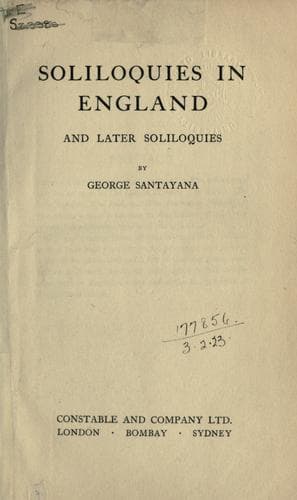
Soliloquies in England, and Later SoliloquiesSantayana, George
Philosophy
Soliloquies in England, and Later Soliloquies
Santayana, George
American essays -- 20th century
his passing visions must take them at their face value, and be content
with that. Fair masks, like flowers, like sunsets, like melodies wrung
out of troubled brains and strung wire, cover for us appropriately the
anatomical face of nature; and words and dogmas are other masks, behind
which we, too, can venture upon the stage; for it is life to give
expression to life, transmuting diffused movements into dear images.
How blind is the zeal of the iconoclasts, and how profoundly hostile
to religious impulse! They pour scorn upon eyes that see not and a
mouth that cannot speak; they despise a work of art or of thought for
being finished and motionless; as if the images of the retina were less
idols than those of the sculptor, and as if words, of all things, were
not conventional signs, grotesque counterfeits, dead messengers, like
fallen leaves, from the dumb soul. Why should one art be contemptuous
of the figurative language of another? Jehovah, who would suffer no
statues, was himself a metaphor.
31
MASKS
When we are children we love putting on masks to astonish our elders;
there is a lordly pleasure in puzzling those harmless giants who are
not in the secret. We ourselves, of course, know that it is only
a disguise; and when presently we pull it off, their surprise at
recognizing us is something deliciously comic. Yet, at bottom, this
compulsory return to nature is a little sad; our young empiricism
would like to take appearances more seriously. To an unsophisticated
mind every transformation seems as credible as it is interesting; there
is always danger and hope of anything. Why should people hesitate to
believe something intrinsically so plausible as that Johnny should
have acquired a bull's head, or that little Alice should suddenly
develop a red nose and furious mustachios? That is just the sort of
thing that would happen if this stupid world were only more natural;
but the trouble with old people is that their minds have become
stagnant, dominated as they are by precedent and prejudice; it is
too much of an exertion for them to imagine anything but what they
have always seen. Even when they tell us about religion, which is so
full of exciting and lovely things that we know _must_ be true, they
seem to be trying to remember something they have read or heard of,
and quite spoil the story; they don't seem to understand at all, as
we do, why it all happens. They are terrible believers in substance,
and can hardly lend themselves to the wayward game of experience.
This after all wouldn't matter so much; it is not worth while playing
with people who don't relish games. The subtlest part of the pleasure
is being blindfolded on purpose and feeling lost when you know you
are not lost. Empiricism would be agony if any one was so silly as
really to forget his material status and to become the sport of his
passing ideas. But masks are great fun in themselves, and when you are
fundamentally sane it is pleasant to play the madman and to yield to
Public-domain text, read in full here on John Shaqi.
Reviews
Reviews
No reviews yet
Be the first to share your thoughts on this work.
Elsewhere in the archive
Join the Discussion
Join the discussion
Sign in to leave a comment or review.
Sign InorCreate an account