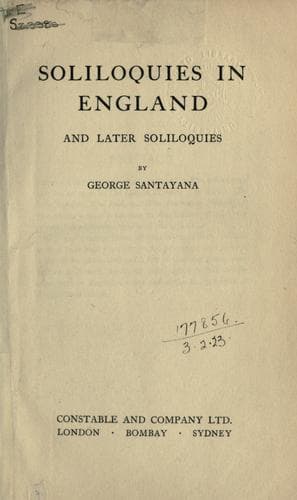
Soliloquies in England, and Later SoliloquiesSantayana, George
Philosophy
Soliloquies in England, and Later Soliloquies
Santayana, George
American essays -- 20th century
Masks are accordingly glorious things; we are instinctively as proud
of designing and wearing them as we are of inventing and using words.
The blackest tragedy is festive; the most pessimistic philosophy is an
enthusiastic triumph of thought. The life which such expressions seem
to arrest or to caricature would be incomplete without them; indeed,
it would be blind and abortive. It is no interruption to experience to
master experience, as tragedy aspires to do; nor is it an interruption
to sink into its episodes and render them consummate, which is the
trick of comedy. On the contrary, without such playful pauses and
reflective interludes our round of motions and sensations would be
deprived of that intellectual dignity which relieves it and renders
it morally endurable--the dignity of knowing what we are doing, even
if it be foolish in itself, and with what probable issue. Tragedy,
the knowledge of death, raises us to that height. In fancy and for a
moment it brings our mortal wills into harmony with our destiny, with
the wages of existence, and with the silence beyond. These discoveries
of reason have fixed the expression of the tragic mask, half horror
and half sublimity. Such is the countenance of man when turned towards
death and eternity and looking beyond all his endeavours at the Gorgon
face of the truth. This is not to say that it is less human, or less
legitimate, to look in other directions and to make other faces. But
whether the visage we assume be a joyful or a sad one, in adopting
and emphasizing it we define our sovereign temper. Henceforth, so
long as we continue under the spell of this self-knowledge, we do not
merely live but act; we compose and play our chosen character, we wear
the buskin of deliberation, we defend and idealize our passions, we
encourage ourselves eloquently to be what we are, devoted or scornful
or careless or austere; we soliloquize (before an imaginary audience)
and we wrap ourselves gracefully in the mantle of our inalienable part.
So draped, we solicit applause and expect to die amid a universal hush.
We profess to live up to the fine sentiments we have uttered, as we try
to believe in the religion we profess. The greater our difficulties
the greater our zeal. Under our published principles and plighted
language we must assiduously hide all the inequalities of our moods and
conduct, and this without hypocrisy, since our deliberate character
is more truly ourself than is the flux of our involuntary dreams. The
portrait we paint in this way and exhibit as our true person may well
be in the grand manner, with column and curtain and distant landscape
and finger pointing to the terrestrial globe or to the Yorick-skull of
philosophy; but if this style is native to us and our art is vital, the
more it transmutes its model the deeper and truer art it will be. The
severe bust of an archaic sculpture, scarcely humanizing the block,
will express a spirit far more justly than the man's dull morning looks
Public-domain text, read in full here on John Shaqi.
Reviews
Reviews
No reviews yet
Be the first to share your thoughts on this work.
Elsewhere in the archive
Join the Discussion
Join the discussion
Sign in to leave a comment or review.
Sign InorCreate an account