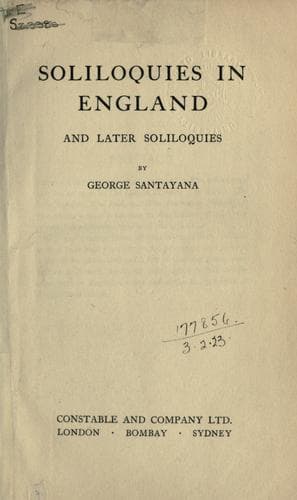
Soliloquies in England, and Later SoliloquiesSantayana, George
Philosophy
Soliloquies in England, and Later Soliloquies
Santayana, George
American essays -- 20th century
or casual grimaces. Every one who is sure of his mind, or proud of his
office, or anxious about his duty assumes a tragic mask. He deputes it
to be himself and transfers to it almost all his vanity. While still
alive and subject, like all existing things, to the undermining flux
of his own substance, he has crystallized his soul into an idea, and
more in pride than in sorrow he has offered up his life on the altar
of the Muses. Self-knowledge, like any art or science, renders its
subject-matter in a new medium, the medium of ideas, in which it loses
its old dimensions and its old pace. Our animal habits are transmuted
by conscience into loyalties and duties, and we become "persons" or
masks. Art, truth, and death turn everything to marble.
That life should be able to reach such expression in the realm of
eternal form is a sublime and wonderful privilege, but it is tragic,
and for that reason distasteful to the animal in man. A mask is not
responsive; you must not speak to it as to a living person, you must
not kiss it. If you do, you will find the cold thing repulsive and
ghastly. It is only a husk, empty, eyeless, brittle, and glazed. The
more comic its expression the more horrible it will prove, being that
of a corpse. The animal in man responds to things according to their
substance, edible, helpful, or plastic; his only joy is to push his
way victoriously through the material world, till a death stops him
which he never thought of and, in a sense, never experiences. He is not
in the least interested in picturing what he is or what he will have
been; he is intent only on what is happening to him now or may happen
to him next. But when the passions see themselves in the mirror of
reflection, what they behold is a tragic mask. This is the escutcheon
of human nature, in which its experience is emblazoned. In so far as
men are men at all, or men of honour, they militate under this standard
and are true to their colours. Whatever refuses to be idealized in
this way, they are obliged to disown and commit to instant oblivion.
It will never do for a mind merely to live through its passions or
its perceptions; it must discern recognizable objects, in which to
centre its experience and its desires; it must choose names and signs
for them, and these names and symbols, if they are to perform their
function in memory and intercourse, must be tightly conventional. What
could be more unseemly than a fault in grammar, or in many a case
more laughable and disconcerting? Yet any solecism, if it were once
stereotyped and made definitely significant, would become an idiom:
it would become a good verbal mask. What is not covered in this way by
some abiding symbol can never be recovered; the dark flood of existence
carries it down bodily. Only in some word or conventional image can
the secret of one moment be flashed to another moment; and even when
there is no one ready to receive the message, or able to decipher it,
Public-domain text, read in full here on John Shaqi.
Reviews
Reviews
No reviews yet
Be the first to share your thoughts on this work.
Elsewhere in the archive
Join the Discussion
Join the discussion
Sign in to leave a comment or review.
Sign InorCreate an account