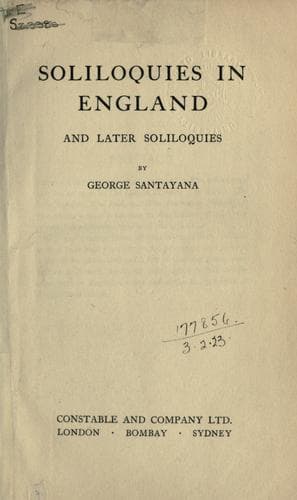
Soliloquies in England, and Later SoliloquiesSantayana, George
Philosophy
Soliloquies in England, and Later Soliloquies
Santayana, George
American essays -- 20th century
of comedy, and the world would grow young. Every occasion would don
its comic mask, and make its bold grimace at the world for a moment.
We should be constantly original without effort and without shame,
somewhat as we are in dreams, and consistent only in sincerity; and we
should gloriously emphasize all the poses we fell into, without seeking
to prolong them.
Objections to the comic mask--to the irresponsible, complete, extreme
expression of each moment--cut at the roots of all expression. Pursue
this path, and at once you do away with gesture: we must not point,
we must not pout, we must not cry, we must not laugh aloud; we must
not only avoid attracting attention, but our attention must not be
obviously attracted; it is silly to gaze, says the nursery-governess,
and rude to stare. Presently words, too, will be reduced to a
telegraphic code. A man in his own country will talk like the laconic
tourist abroad; his whole vocabulary will be _Où? Combien? All right!
Dear me!_ Conversation in the quiet home will dispense even with these
phrases; nothing will be required but a few pragmatic grunts and
signals for action. Where the spirit of comedy has departed, company
becomes constraint, reserve eats up the spirit, and people fall into
a penurious melancholy in their scruple to be always exact, sane, and
reasonable, never to mourn, never to glow, never to betray a passion
or a weakness, nor venture to utter a thought they might not wish to
harbour for ever.
Yet irony pursues these enemies of comedy, and for fear of wearing
a mask for a moment they are hypocrites all their lives. Their very
reserve becomes a pose, a convention imposed externally, and their
mincing speech turns to cant. Sometimes this evasion of impulsive
sentiment fosters a poignant sentimentality beneath. The comedy goes
on silently behind the scenes, until perhaps it gets the upper hand
and becomes positive madness; or else it breaks out in some shy,
indirect fashion, as among Americans with their perpetual joking.
Where there is no habitual art and no moral liberty, the instinct for
direct expression is atrophied for want of exercise; and then slang
and a humorous perversity of phrase or manner act as safety-valves to
sanity; and you manage to express yourself in spite of the censor by
saying something grotesquely different from what you mean. That is a
long way round to sincerity, and an ugly one. What, on the contrary,
could be more splendidly sincere than the impulse to play in real life,
to rise on the rising wave of every feeling and let it burst, if it
will, into the foam of exaggeration? Life is not a means, the mind is
not a slave nor a photograph: it has a right to enact a pose, to assume
a _panache_, and to create what prodigious allegories it will for the
mere sport and glory of it. Nor is this art of innocent make-believe
forbidden in the Decalogue, although Bible-reading Anglo-Saxondom
might seem to think so. On the contrary, the Bible and the Decalogue
Public-domain text, read in full here on John Shaqi.
Reviews
Reviews
No reviews yet
Be the first to share your thoughts on this work.
Elsewhere in the archive
Join the Discussion
Join the discussion
Sign in to leave a comment or review.
Sign InorCreate an account