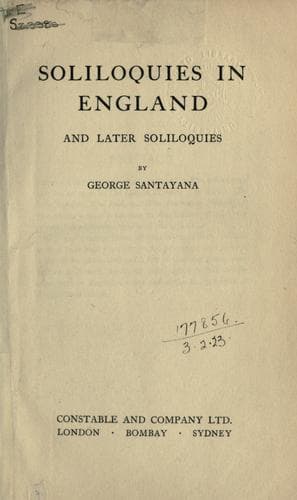
Soliloquies in England, and Later SoliloquiesSantayana, George
Philosophy
Soliloquies in England, and Later Soliloquies
Santayana, George
American essays -- 20th century
Paganism was full of scruples and superstitions in matters of behaviour
or of _cultus_, since the _cultus_ too was regarded as a business or a
magic craft; but in expression, in reflection, paganism was frank and
even shameless; it felt itself inspired, and revered this inspiration.
It saw nothing impious in inventing or recasting a myth about no matter
how sacred a subject. Its inspiration, however, soon fell into classic
moulds, because the primary impulses of nature, though intermittent,
are monotonous and clearly defined, as are the gestures of love and of
anger. A man who is unaffectedly himself turns out to be uncommonly
like other people. Simple sincerity will continually rediscover the old
right ways of thinking and speaking, and will be perfectly conventional
without suspecting it. This classic iteration comes of nature, it is
not the consequence of any revision or censorship imposed by reason.
Reason, not being responsible for any of the facts or passions that
enter into human life, has no interest in maintaining them as they
are; any novelty, even the most revolutionary, would merely afford
reason a fresh occasion for demanding a fresh harmony. But the Old
Adam is conservative; he repeats himself mechanically in every child
who cries and loves sweets and is imitative and jealous. Reason,
with its tragic discoveries and restraints, is a far more precarious
and personal possession than the trite animal experience and the
ancestral grimaces on which it supervenes; and automatically even the
philosopher continues to cut his old comic capers, as if no such thing
as reason existed. The wiseacres too are comic, and their mask is
one of the most harmlessly amusing in the human museum; for reason,
taken psychologically, is an old inherited passion like any other, the
passion for consistency and order; and it is just as prone as the other
passions to overstep the modesty of nature and to regard its own aims
as alone important. But this is ridiculous; because importance springs
from the stress of nature, from the cry of life, not from reason and
its pale prescriptions. Reason cannot stand alone; brute habit and
blind play are at the bottom of art and morals, and unless irrational
impulses and fancies are kept alive, the life of reason collapses for
sheer emptiness. What tragedy could there be, or what sublime harmonies
rising out of tragedy, if there were no spontaneous passions to create
the issue, no wild voices to be reduced to harmony? Moralists have
habitually aimed at suppression, wisely perhaps at first, when they
were preaching to men of spirit; but why continue to harp on propriety
and unselfishness and labour, when we are little but labour-machines
already, and have hardly any self or any passions left to indulge?
Perhaps the time has come to suspend those exhortations, and to
encourage us to be sometimes a little lively, and see if we can invent
something worth saying or doing. We should then be living in the spirit
Public-domain text, read in full here on John Shaqi.
Reviews
Reviews
No reviews yet
Be the first to share your thoughts on this work.
Elsewhere in the archive
Join the Discussion
Join the discussion
Sign in to leave a comment or review.
Sign InorCreate an account