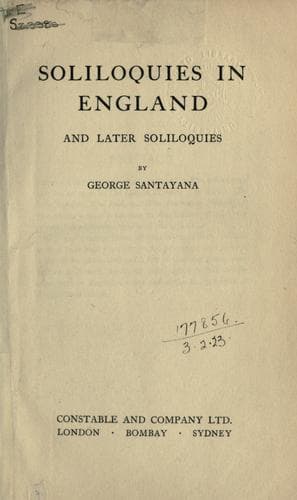
Soliloquies in England, and Later SoliloquiesSantayana, George
Philosophy
Soliloquies in England, and Later Soliloquies
Santayana, George
American essays -- 20th century
English lovers, I believe, seldom practise what in Spain is called
conjugating the verb; they do not spend hours ringing the changes on I
love, you love, we love. This, in their opinion, would be to protest
too much. They prefer the method of Paolo and Francesca: they will
sit reading out of the same book, and when they come to the kissing,
she will say, "How nice that is!" and he will reply, "Isn't it?" and
the story will supply the vicarious eloquence of their love. Fiction
and poetry, in some supposititious instance, report for the Englishman
the bashful truth about himself; and what English life thereby misses
in vivacity, English literature gains in wealth, in tenderness, in a
rambling veracity, and in preciousness to the people's heart.
36
A CONTRAST WITH SPANISH DRAMA
In classical Spanish drama the masks are few. The characters hardly
have individual names. The lady in Calderon, for instance, if she is
not Beatriz will be Leonor, and under either name so superlatively
beautiful, young, chaste, eloquent, devoted, and resourceful, as to be
indistinguishable from her namesakes in the other plays. The hero is
always exaggeratedly in love, exaggeratedly chivalrous, and absolutely
perfect, save for this heroic excess of sensitiveness and honour.
The old father is always austere, unyielding, perverse, and sublime.
All the maids in attendance possess the same roguishness, the same
genius for intrigue and lightning mendacity; whilst the valet, whether
called Crispin or Florin, is always a faithful soul and a coward,
with the same quality of rather forced humour. No diversity from play
to play save the diversity in the fable, in the angle at which the
stock characters are exhibited and the occasion on which they versify;
for they all versify in the same style, with the same inexhaustible
facility, abundance, rhetorical finish, and lyric fire.
Why this monotony? Did Spanish life afford fewer contrasts, less
individuality of character and idiom, than did the England of
Shakespeare? Hardly: in Spain the soldier of fortune, the grandee,
peasant, monk, or prelate, the rogue, beggar, and bandit were surely
as highly characterized as anything to be then found in England; and
Spanish women in their natural ardour of affection, in their ready
speech and discretion, in their dignity and religious consecration,
lent themselves rather better, one would think, to the making of
heroines than did those comparatively cool and boylike young ladies
whom Shakespeare transmuted into tragic angels. I think we may go
further and say positively that it was Spain rather than England that
could have shown the spectacle of "every man in his humour."
Public-domain text, read in full here on John Shaqi.
Reviews
Reviews
No reviews yet
Be the first to share your thoughts on this work.
Elsewhere in the archive
Join the Discussion
Join the discussion
Sign in to leave a comment or review.
Sign InorCreate an account