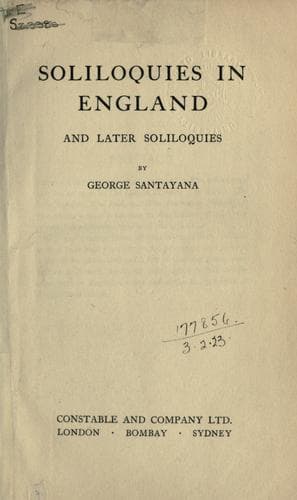
Soliloquies in England, and Later SoliloquiesSantayana, George
Philosophy
Soliloquies in England, and Later Soliloquies
Santayana, George
American essays -- 20th century
Even in the days before Puritanism English character was English;
it tended to silent independence and outward reserve, preferring
to ignore its opposite rather than to challenge it. In pose and
expression the Spaniard is naturally more theatrical and pungent; and
his individuality itself is stiffen No doubt, in society, he will
simulate and dissimulate as an Englishman never would; but he is
prompted to this un-English habit by the very fixity of his purposes;
all his courtesy and loyalty are ironical, and inwardly he never yields
an inch. He likes if possible to be statuesque; he likes to appeal
to his own principles and character, and to say, "Sir, whatever you
may think of it, that is the sort of man I am." He has that curious
form of self-love which inclines to parade even its defects, as a
mourner parades his grief. He admits readily that he is a sinner,
and that he means to remain one; he composes his countenance proudly
on that basis; whereas when English people say they are miserable
sinners (which happens only in church) they feel perhaps that they are
imperfect or unlucky, and they may even contemplate being somewhat
different in future; but it never occurs to them to classify themselves
as miserable sinners for good, with a certain pride in their class,
deliberately putting on the mask of Satan or the cock's feather of
Mephistopheles and saying to all concerned, "See what a very devil I
am!" The Englishman's sins are slips; he feels he was not himself on
those occasions, and does not think it fair to be reminded of them.
Though theology may sometimes have taught him that he is a sinner
fundamentally, such is not his native conviction; the transcendental
ego in him cannot admit any external standard to which it ought to have
conformed. The Spaniard is metaphysically humbler, knowing himself
to be a creature of accident and fate; yet he is dramatically more
impudent, and respects himself more than he respects other people. He
laughs at kings; and as amongst beggars it is etiquette to whine, and
ostentatiously to call oneself blind, old, poor, crippled, hungry, and
a brother of yours, so amongst avowed sinners it may become a point of
pride to hold, as it were, the record as a liar, a thief, an assassin,
or a harlot. These rôles are disgraceful when one is reduced to them
by force of circumstances or for some mean ulterior motive, but they
recover their human dignity when one wears them as a chosen mask in
the comedy of life. The pose, at that angle, redeems the folly, and
the façade the building. Nor is this a lapse into sheer immorality;
there is many a primitive or animal level of morality beneath the
conventional code; and often crime and barbarism are as proud of
themselves as virtue, and no less punctilious. If there is effrontery
in such a rebellion, there may be also sincerity, courage, relief,
profound truth to one's own nature. Hence the eloquence of romanticism.
Public-domain text, read in full here on John Shaqi.
Reviews
Reviews
No reviews yet
Be the first to share your thoughts on this work.
Elsewhere in the archive
Join the Discussion
Join the discussion
Sign in to leave a comment or review.
Sign InorCreate an account