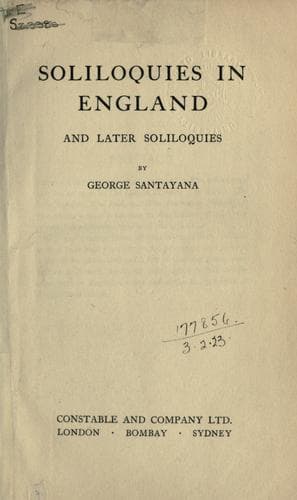
Soliloquies in England, and Later SoliloquiesSantayana, George
Philosophy
Soliloquies in England, and Later Soliloquies
Santayana, George
American essays -- 20th century
Such a people will not go to the play to be vaguely entertained, as
if they were previously bored. They are not habitually bored; they
are full to the brim of their characteristic passions and ideas. They
require that the theatre should set forth these passions and ideas as
brilliantly and convincingly as possible, in order to be confirmed in
them, and to understand and develop them more clearly. Variety of plot
and landscape they will relish, because nothing is easier for them than
to imagine themselves born in the purple, or captive, or in love, or in
a difficult dilemma of honour; and they will be deeply moved to see
some constant spirit, like their own, buffeted by fortune, but even in
the last extremity never shaken. The whole force of their dramatic art
will lie in leading them to dream of themselves in a different, perhaps
more glorious, position, in which their latent passions might be more
splendidly expressed. These passions are intense and exceptionally
definite; and this is the reason, I think, for the monotony of Spanish
music, philosophy, and romantic drama. All eloquence, all issues, all
sentiments, if they are not to seem vapid and trivial, must be such as
each man can make his own, with a sense of enhanced vitality and moral
glory. The lady, if he is to warm to her praises, must not be less
divine than the one he loves, or might have loved; the hero must not
fall short of what, under such circumstances, he himself would have
wished to be. The language, too, must always be worthy of the theme:
it cannot be too rapturous and eloquent. Unless his soul can be fired
by the poet's words, and can sing them, as it were, in chorus, he will
not care to listen to them. But he will not tire of the same cadences
or the same images--stars, foam, feathers, flowers--if these symbols,
better than any others, transport him into the ethereal atmosphere
which it is his pleasure to breathe.
Public-domain text, read in full here on John Shaqi.
Reviews
Reviews
No reviews yet
Be the first to share your thoughts on this work.
Elsewhere in the archive
Join the Discussion
Join the discussion
Sign in to leave a comment or review.
Sign InorCreate an account