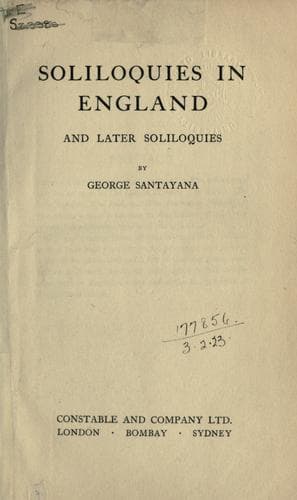
Soliloquies in England, and Later SoliloquiesSantayana, George
Philosophy
Soliloquies in England, and Later Soliloquies
Santayana, George
American essays -- 20th century
Passion and wilfulness (which romanticists think are above criticism)
cannot be expected to understand that, if they merged and subsided
into a harmony, the life distilled out of their several deaths would
be infinitely more living and varied than any of them, and would be
beautiful and perfect to boot; whereas the romantic chaos which they
prolong by their obstinacy is the most hideous of hells. But avowed
sinners and proud romanticists insist on preserving and on loving hell,
because they insist on loving and preserving themselves.
It was not, then, moral variety that was lacking in Spain, always a
romantic country, but only interest in moral variety. This lack of
interest was itself an expression of romantic independence, intensity,
and pride. The gentleman with his hand always on the hilt of his sword,
lest some whiff from anywhere should wound his vanity, or the monk
perpetually murmuring _memento mori_, closed his mind to every alien
vista. Of course he knew that the world was full of motley characters:
that was one of his reasons for holding it at arm's length. What were
those miscellaneous follies to him but an offence or a danger? Why
should he entertain his leisure in depicting or idealizing them? If
some psychological zoologist cared to discant on the infinity of
phenomena, natural or moral, well and good; but how should such things
charm a man of honour, a Christian, or a poet? They might indeed be
referred to on occasion, as fabulists make the animals speak, with a
humorous and satirical intention, as a sort of warning and confirmation
to us in our chosen path; but an appealing poet, for such tightly
integrated minds, must illustrate and enforce their personal feelings.
Moreover, although in words and under the spell of eloquence the
Spaniard may often seem credulous and enthusiastic, he is disillusioned
and cynical at heart; he does not credit the existence of motives or
feelings better than those he has observed, or thinks he has observed.
His preachers recommend religion chiefly by composing invectives
against the world, and his political writers express sympathy with one
foreign country only out of hatred for another, or perhaps for their
own. The sphere of distrust and indifference begins for him very near
home; he has little speculative sympathy with life at large; he is
cruel to animals; he shrugs his shoulders at crime in high places; he
feels little responsibility to the public, and has small faith in time
and in work. This does not mean in the least that his character is weak
or his morality lax within its natural range; his affections are firm,
his sense of obligation deep, his delicacy of feeling often excessive;
he is devoted to his family, and will put himself to any inconvenience
to do a favour to a friend at the public expense. There are definite
things to which his sentiments and habits have pledged him: beyond that
horizon nothing speaks to his heart.
Public-domain text, read in full here on John Shaqi.
Reviews
Reviews
No reviews yet
Be the first to share your thoughts on this work.
Elsewhere in the archive
Join the Discussion
Join the discussion
Sign in to leave a comment or review.
Sign InorCreate an account