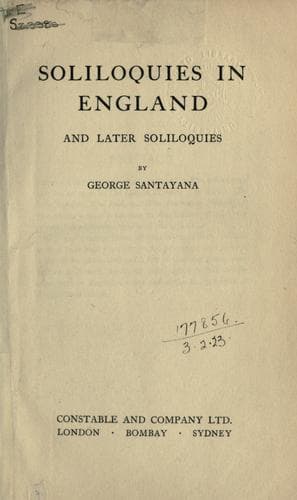
Soliloquies in England, and Later SoliloquiesSantayana, George
Philosophy
Soliloquies in England, and Later Soliloquies
Santayana, George
American essays -- 20th century
This sight was so welcome to those heartsick passengers, that they
could not wait for the ship to make fast, though they steered her
straight for the coast, but jumped over-board and eagerly swam ashore.
Their example was contagious. The other party could not bear to be left
behind without experiencing the new life, whatever it might bring. They
reflected that as the land was really a part of the sea, it was not
bad seamanship sometimes to run aground, that in leaving the ship they
would, in a higher sense, be continuing their voyage, and that they
would not be true to the supreme principle of their philosophy, which
was absolute free-will, if they did not often change their principles
in minor matters. The chief point was to experience everything. They
did not regret the past, as did their narrow-minded positivistic
friends, simply because it had involved hardships and errors. Hardships
and errors were blessings, if you could only outgrow them; and they,
in their splendid vitality, knew how to outgrow everything. Sacred
history, classic fable, chivalry, and the cure of one's soul had,
in that former age, proved absorbing themes for the fancy, and had
exquisitely modulated the emotions; but the fountain of those emotions
had always been their own breast, and since after such dramatic
adventures their breast remained deeply unsatisfied, it was time to
look again narrowly into its depths to discover some newer and truer
way of expressing it. Why should not the development of material arts
be the next phase in their career? They would not be less free amid the
gusts and the billows of politics than they had been in their marine
adventure; commerce would offer them glorious opportunities to exercise
their will-power and their invention; infinite vistas, here too, were
open before them: cities always more populous, possessions always more
varied, instruments always more wonderful, and labour always more
intense.
The romantic party accordingly joined the lovers of material progress
in their new city, called Mechanapolis: but the old opposition in their
temperaments remained undiminished. The lovers of adventure wanted
machines in order to make war, and the lovers of thrift wanted peace in
order to make other machines.
Meantime Peter the captain, with much grumbling and shaking of
his grey beard, had got the old _Saint Christopher_ afloat again,
and accompanied still by a faithful boatswain and cook, and some
nondescript recruits that he had got together, set out again to sea, in
search of that other land beyond the ocean which is called heaven. And
every evening with a trembling finger he pointed to it in the setting
sun, not seeing that heaven was above his head.
40
CLASSIC LIBERTY
Public-domain text, read in full here on John Shaqi.
Reviews
Reviews
No reviews yet
Be the first to share your thoughts on this work.
Elsewhere in the archive
Join the Discussion
Join the discussion
Sign in to leave a comment or review.
Sign InorCreate an account